Showing posts with label Los Angeles. Show all posts

Monday, October 19, 2026

Typography: The Typosium, Los Angeles, 1925

On April 14, 1925, Laurie J. Quinby filed a trademark application for The Typosium. It appeared in the Official Gazette of the United States Patent Office, July 7, 1925


Typosium excerpts and quotes in
  1. American Stationer and Office Manager, May 9, 1925
  2. Visalia Morning Delta (California), June 24, 1925 and June 28, 1925
  3. California Highways, August 1925
  4. The Rustler (King City, California), September 4, 1925
  5. Merced Express (California), October 1, 1926
  6. The Inland Printer, July 1927
  7. Sacramento Daily Union (California), February 2, 1928

A Few Details About Laurie John Quinby

 
Laurie John Quinby was born on December 8, 1868 in Covington, Kentucky according to Genealogical History of the Quinby (Quimby) Family in England and America (1915). His parents were Joseph Bailey Quinby and Annie Laurie. Quinby explained why he changed his birth name.
“Because I was born on the birthday of my mother’s brother, John Laurie, they named me for him. Later in life I preferred to reverse the order of these names, calling myself Laurie John; you see the tendency always was with me to arrange things to suit myself. For doing this, however, I had some reason. In those days there was a prize fighter who had made himself quite notorious. His name was John L. Sullivan. I had no liking for ‘sluggers,’ and so boys and men, whether to irritate me or not, would speak of me as John L., just as they did of him. I did not like that. Then I thought that Laurie J. Quinby sounded a bit more euphonious, that it was better balanced and such like things, all of which at that time did and still do seem sufficient reason for my writing my name as I please. Then a name is only a label, and I see no reason why any one should not be conceded the right to write his name as he chooses, regardless of any other consideration. However, I have always gone on the theory that if I have ever done anything I should be sorry for I am glad of it, for in the doing of those things we at least learn the lessons of right conduct. We learn what not to do the next time. ...
The 1870 United States Census counted six-and-a-half-month-old Quinby (line four) as the youngest of seven siblings. The family lived in Cincinnati, Ohio. Quinby’s father was a newspaper editor (line 36).


In the 1880 census, the Quinby family (lines two through nine) were residents on Jefferson Street of Dayton, Kentucky. Three of Quinby’s older brothers were printers.


On March 12, 1892, Quinby married Cora A. Clinkinbeard at Boyd, Kentucky.


Direct Legislation Record, March 1899, profiled Quinby.


Direct Legislation Record, September 1900, reviewed, on page 48, Quinby’s booklet, The Open Door.

According to the 1900 census, Quinby (line 53), his wife and daughter, Minerva, made their home in Omaha, Nebraska. They were lodgers in the Majors household at 223 Howard Street. Quinby was a printer.


Quinby (line 34) had the same profession in the 1910 census. His family lived in Dundee, Nebraska at 4916 Dodge Street.


Quinby attended and spoke at the first annual picnic of the printing trades of Omaha.

The 1920 census, enumerated January 13, listed Quinby on line 45. The magazine editor lived in Seattle, Washington at 907 Boren Avenue.


A month later on February 12, 1920, which was Abraham Lincoln’s birthday, the Seattle Post-Intelligencer, published Quinby’s “Abraham Lincoln”.


In the early 1920s Quinby moved to Los Angeles, California where his wife, Cora, passed away on July 8, 1923.

In 1925, the Typosium published Three Paths: An Allegorical Romance which was written by Wallace Clifton, a pseudonym of Quinby.

The 1930 census said Quinby (line 14), his daughter and granddaughter, Jocelyn, lived at 1717 North Alexandria Avenue in Los Angeles. His household included five lodgers. Sixty-one-year-old Quinby was not working.


The American Republic of States and Democracy of Citizens was Quinby’s next book published by the Typosium in 1930.

Quinby’s Jefferson-Lincoln Symposium of What Constitutes Americanism was published by the Davies Printing Company in 1936.

At some point, Quincy married Harriet Brockway Weaver. In the 1940 census, the couple (lines 12 and 13) were counted in Los Angeles at 1119 South Victoria Avenue.


Seven-and-a-half months later, Quinby passed away on November 17, 1940 in Los Angeles. He was laid to rest at Hollywood Forever.

The Lincoln Star (Nebraska), November 22, 1940, said
Laurie Quinby, Former State Senator, Dies
Omaha, Nov. 22—Friends here were notified today of the death at Los Angeles Nov. 16 of Laurie J. Quinby, 71, one­ time prominent Omahan and a state senator in 1914.
The Freeman, January 1941, said
Laurie J. Quinby died in Los Angeles on November 17, after a long illness. He was 71 years old.

Mr. Quinby, a veteran Georgist, was for many years engaged in journalism and politics. He had published several books, and was much sought after as a public speaker. He wrote his own obituary, an inspired work which is published in the current issue of Land and Freedom.

Mr. Quinby’s body was cremated. He is survived by his widow, Harriet Quinby; by a daughter, Minerva Quinby Ingold, and a granddaughter, Jocelyn Ingold.

(Next post on Monday: Art Direction 1967)

Monday, January 5, 2026

Comics: Mel Millar, Animation Artist and Writer, Cartoonist and Letterer

Mel Millar, also known as Tubby Millar, was born Melvin Eugene Miller on May 6, 1900, in Portis, Kansas. The birth information is from his World War II draft card. (His World War I draft card is not available.) The surname spelling changed in the second half of the 1920s. 

The 1900 United States Census, enumerated on June 1, said Millar was the only child of Dan and Nora, both Kansan natives. They lived in Bethany, Kansas. Millar’s father was a section hand on the railroad.


The 1905 Kansas state census and 1910 census counted Millar, his mother and sister, Irene, in the household of his maternal grandparents Robert and Clara Bell. They were Bethany residents. The status of Millar’s father is unknown.


The Department of Veterans Affairs BIRLS Death File, at Ancestry.com, said Millar served in the Navy from June 1, 1918 to May 31, 1922. 

According to the 1920 census, unemployed Millar and his sister were counted in the household of their maternal grandmother in Portis, Kansas. Due to his naval service, Millar may not have been home during the enumeration. Their mother had remarried to James A. St. Clair, a carpenter, and lived close by.


The 1925 Kansas state census said Millar was a laborer who stayed with his grandmother in Portis. His mother lived nearby. 


There are differing accounts of Millar’s art training. The Van Nuys News (California), May 5, 1949 said 
... Finishing high school, he served a short hitch in the Navy, then came out determined to pursue art as a career and specialized in cartooning at the Chicago Academy of Fine Arts. ...
The Valley News (Van Nuys, California), December 28, 1967 said
... In 1920 Millar graduated from the Chicago Academy of Fine Arts. ... 
The Wichita Eagle (Kansas), November 23, 2009 said 
... After high school, Millar went on to the Kansas City Art Institute and then off to Hollywood to draw pictures for a living. ...
... Melvin graduated from Portis High School in 1918 and attended the Kansas City Art School in Missouri. ...
In the 1930 census, Millar lived in Kansas City, Missouri at 72 East 31st Street. He was a cartoonist working at a film advertising company. The Valley News said his employer was “the United Film Ad Service in Kansas City, Mo., from 1927 until he came to California in 1931”. The 2005 book, Living Life Inside the Lines: Tales from the Golden Age of Animation, said the company name was Kansas City Film Ad Service. The census also revealed the new spelling of his surname. Millar’s mother and step-brother were Topeka, Kansas residents. 


The Van Nuys News said Millar worked at Warner Bros. from 1931 to 1944. He is mentioned several times in That’s All Folks!: The Art of Warner Bros. Animation (1988). 

At Ancestry.com, the 1938 California Voter Registration record said Millar was a cartoonist and Democrat whose address was 2709 South Alameda Street in Los Angeles.

Millar was at the same address in the 1940 census. He was married to Myrtle who passed away later that year on October 9. His home was valued at $3,500. Millar completed four years of high school and earned $2,800 in 1939. Millar’s mother and step-brother lived in Riverside, California.


On February 14, 1942, Millar signed his World War II draft card. His address was 2709 Alameda in Burbank. His employer was Leon Schlesinger. Millar’s description was five feet six inches, 195 pounds, with brown hair and blue eyes. He named his mother, who had remarried, as next of kin.


Millar was the cartooning and animation instructor at the Hollywood Art Center School as seen in an advertisement from the Hollywood Citizen News, May 25, 1946. 


Miller was a comic book letterer. In Walt’s People, Volume 11 (2011), Alberto Becattini interviewed Don Christiansen who said, “... ‘Tubby’ Millar, whom I had worked with at Schlesinger/Warner Bros., did all the lettering for Sangor.” 

At Dogpatch Press, the introduction to “Funny-animal comics retrospective: The History of Hi-Jinx and the Hepcats by Fred Patten”, said 
... Much of the remaining information is from The Comic Art of Jack Bradbury, a website created by his son, Joel (http://jbrad.org/index.html); and from Dave Bennett, a Hollywood animator and funny-animal fan for decades who knew Hi-Jinx’s artist Jack Bradbury personally. Bennett says, “Jack told me himself that all the Hepcats stories he drew were written by Cal Howard—he raved about how good he thought they were!  Other than those stories and the Disney work he did, Jack wrote all of his ACG/Nedor/Pines/Standard stories himself.  They were lettered by Tubby Millar.” ...
A comment from Steven Rowe, on Todd’s Blog, said 
Davis packaged comics for Richard Hughes to send to ACG, DC, and Standard-Pines from 1945 to c1948. I’ve seen a Hughes record of what he (Hughes) sent one month to the various companies. Davis was getting stories from other folks in the LA area animation studio. “Tubby” Mel Millar was the main letterer. DC would use NYC artists for covers and text stories. Millar also drew the “Talking Komics”, which may include his lettering. ...
Many of the comic books with Millar’s lettering are listed at the end of this post. Below are splash pages from Ha Ha Comics #20, June 1945.


The Daily News (Los Angeles, California), November 30, 1948, covered the creation of Talking Komics. 

The Educational Screen, September 1949, said 
Talking Komics will give second and third graders who can read pleasure and satisfaction, although little challenge. Produced by Belda, these include Grumpy Shark, Lonesome Octopus, Happy Grasshopper, Chirpy Cricket and Sleepy Santa. Each is a simple story well told in both audio and visual form. In each case a record telling the story is accompanied by a “comic” book telling the same story, using precisely the same words and illustrating the story through conventional cartoon techniques. This form of presentation does not allow sufficient leeway for imaginative interpretation by the child. The records are best suited to individual pursuit rather than general class presentation hey are well done, of fair general educational value, and may assist in reading.
Millar drew Grumpy Shark, Lonesome Octopus and possibly others.

The Van Nuys News, May 5, 1949, introduced Millar’s advertising character, Little Slocum.
… He is a pen-child created by Mel Millar, nationally known cartoonist and illustrator, and has been devised by Millar to tell the thousands of Valley residents about Slocum Furniture Co. at 6187 Van Nuys Blvd., and of the wide selection of home furnishings to be found there at attractive prices.

… Now readers of The News will see Millar’s famous drawings in each issue of this newspaper, and will enjoy them thoroughly, as they will enjoy Little Slocum’s periodic appearances in these pages to act as an alter ego to the cartoons, and to carry the Slocum Furniture message to the public.

“I have a theory that cartoons are the best attention getters, and I sincerely hope everyone will enjoy meeting up with Little Slocum as he greets you in these columns, and also will enjoy the creations I shall draw for publication in The News,” was Millar’s statement today in discussing this new series.
Van Nuys News, May 9, 1949

Van Nuys News, May 26, 1949

The 1950 census said freelance cartoonist Millar was a widower. He and his step-daughter resided in Burbank at 120 Beachwood. 


Millar was one of several cartoonists listed in the Cartoonists’ Market Letter advertisement, “How to Draw Magazine Cartoons”, that was printed in Writer’s Digest, May 1953 and June 1953. 

Millar was one of many cartoonists represented by agent Lew Card who advertised in Writer’s Digest, January 1957. 

Some of Millar’s cartoons, selected by comedian Ed Wynn, were published in Parade Magazine, April 27, 1958. 

Millar ran a classified advertisement for his cartooning brochures in Writer’s Digest, January 1959. 

In late 1967, Door Doodles was copyrighted by Millar. 

The Valley News, December 28, 1967, said 
… Mel Millar who resides at 120 S. Beachwood Drive with his wife Helen and their two cats. …

“No art school can make a cartoonist. They only teach one to draw,” Millar stated. He said cartoonists interpret differently than other artists and views cartooning as an art within an art.

“A cartoonist is an artist, but an artist is not necessarily a cartoonist,” Millar said

“Artists reflect themselves, whereas cartoonists reflect the situation in a gentle satire,” he added.

As far as “what” makes the cartoonist, Millar said:  “It is the humor or satire of the idea that makes the cartoonist. And the originating of the ideas comes from observation and accumulated experiences of the various things one has seen or done.”

He said that cartoonists have an art of visualizing the humor in situations which many people miss until they actually see it in the cartoon.

The professional cartoonist must be versatile, refreshing understanding, and have a wide range of interests, according to Millar.
From 1972 to 1975, Editor and Publisher listed Millar’s Betty Botch and Bob Botch cartoon panels that were distributed by Pat Anderson Features.

Millar’s mother passed away on October 1, 1975 in Los Angeles. 

Millar passed away on December 30, 1980, in Burbank, California. He was laid to rest at Forest Lawn Memorial Park. 


Further Reading and Viewing
Historical Marker Database, In Memory of Melvin “Tubby” Millar
The Osborne County Hall of Fame, Melvin “Tubby” Miller – 1996 Inductee
Grand Comics Database, Melvin Millar and Tubby Millar

Digital Comic Museum, comics with Millar lettering
Barnyard Comics #9, December 1946
Barnyard Comics #14, October 1947
Coo Coo Comics #23, March 1946
Coo Coo Comics #26, June 1946
Coo Coo Comics #27, July 1946
Coo Coo Comics #28, August 1946
Coo Coo Comics #32, March 1947
Coo Coo Comics #35, September 1947
Coo Coo Comics #36, November 1947
Coo Coo Comics #39, May 1948
Coo Coo Comics #40, July 1948
Coo Coo Comics #43, January 1949
Coo Coo Comics #44, March 1949
Goofy Comics #15, August 1946
Goofy Comics #16, October 1946
Goofy Comics #29, December 1948
Ha Ha Comics #20, June 1945
Ha Ha Comics #24, December 1945
Ha Ha Comics #26, February 1946
Ha Ha Comics #29, May 1946
Ha Ha Comics #33, September 1946
Ha Ha Comics #34, October 1946
Ha Ha Comics #38, February 1947
Ha Ha Comics #44, August 1947
Ha Ha Comics #46, October 1947

Internet Archive, gag cartoons in various trade magazines
Cartoon Research, Animation Anecdotes #221
Looney Tunes Wiki, Melvin Millar photograph
Michael Barrier, Melvin “Tubby” Millar in group photograph 
Tralfaz, Another Inside Joke
Tripod, Melvin “Tubby” Millar
East of Borneo, Henry Lovins and the Lost Hollywood Art Center School 


Related Posts


Monday, April 14, 2025

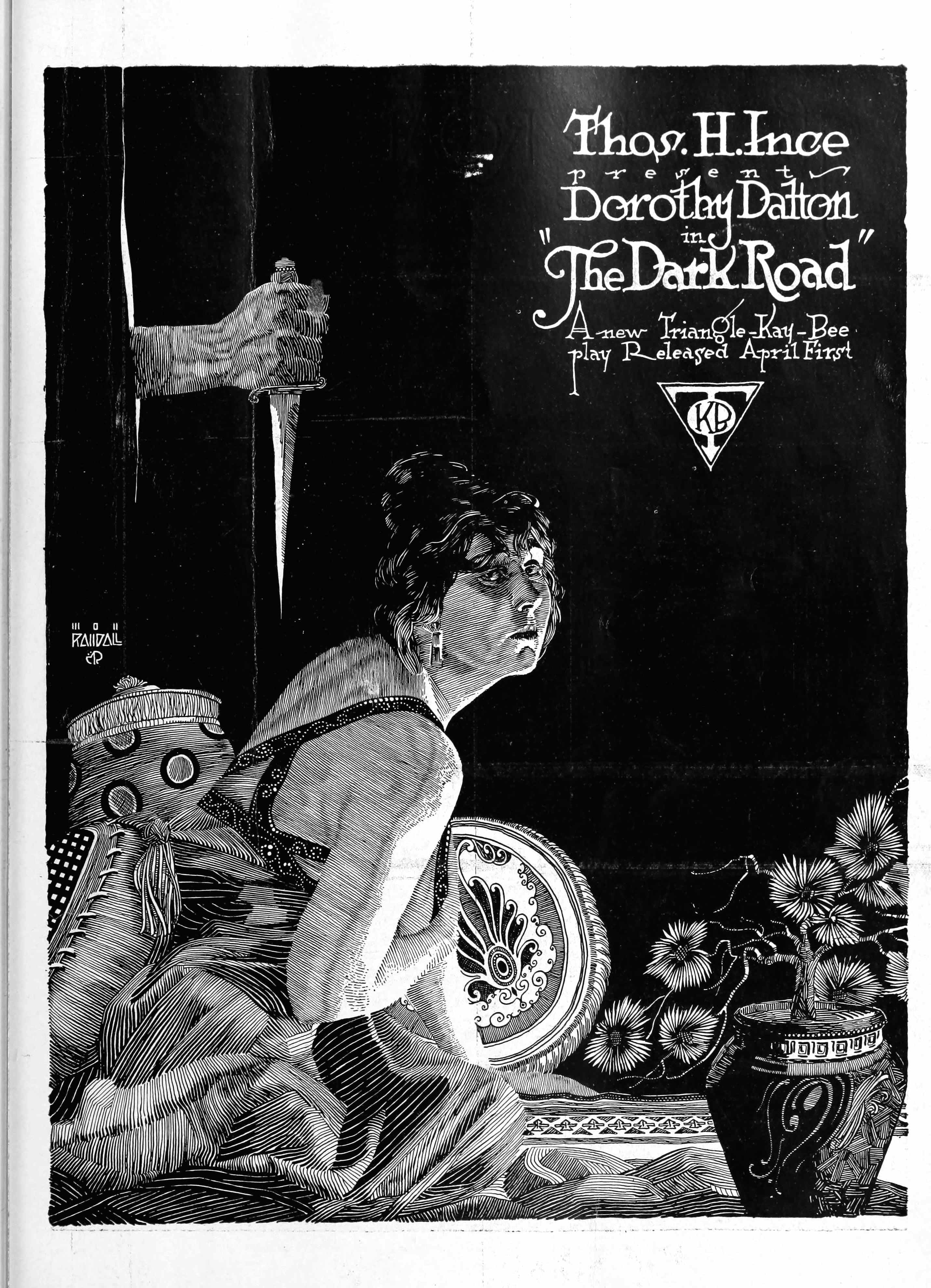
Creator: Mon Randall, Cartoonist and Illustrator

April 13, 1890, Salt Lake City, Utah – July 20, 1935, Riverside, California 


 Selected art from 1907 to 1930

1907–1908
The Tiger
California School of Mechanical Arts
San Francisco, California


 1913–1914


1917
Moving Picture World 


1918


1919


1920


1921


1923


1926–1927


Theatre Magazine, March 1927
Touring Topics, October 1927
 
 
1930


Related Posts
 
(Next post on Monday: Labels, Part 2)