Raymond Albert “Ray” Burley was born on February 23, 1890, in Ainsworth, Nebraska, according to this World War I and II draft cards. His parents were Albert William Burley of Canada, and Mary Cornish of Indiana. They married in Midvaile, Nebraska on December 12, 1897.
In the 1900 United States Census, Burley (line 54) was the oldest of three brothers. The family included their maternal grandmother. They resided in Blaine, Washington on B Street. Burley’s father was a day laborer.

The 1910 census counted the Burleys in Everett, Washington at 3425 Rucker Avenue. Burley was a sign painter (line 86). The 1911 Everett city directory said Burley’s employer was the Westbrook Sign Company.

At some point, Burley moved to New York City.
On June 5, 1917, Burley signed his World War I draft card. His address was 60 West 66th Street in Manhattan, New York City. He was an unemployed artist. His description was five feet nine inches, medium build, with blue eyes and blonde hair.

Burley’s New York service card said he was inducted on May 27, 1918. He was in Company C of the 51st Pioneer Infantry and served overseas from July 26, 1918 to July 3, 1919. He was honorably discharged on July 10, 1919. A record of his service was in Snohomish County in the War: The Part Played in the Great War by the Soldiers, Sailors, Marines and Patriotic Civilians of Snohomish County, Washington, U.S.A.

At the Field Guide to Wild American Pulp Artists, David Saunders said Burley studied at the Art Students League from 1919 to 1923.
Burley contributed illustrations to several pulp magazines.

Courtesy of Heritage Auctions
Burley has not yet been found in the 1920 census and 1925 New York state census.
According to the 1930 census, Burley (line 34) lived in Manhattan at 217 West 14th Street. He was a self-employed artist. His roommate worked in advertising.

The Springfield Republican (Massachusetts), January 18, 1934, said
New York, Jan. 17—The Phelps Publishing company of Springfield, with a claim of $4813, is one of three petitioning creditors who today filed an involuntary petition in bankruptcy in federal court here against the Criterion Magazine Publishing company, inc., publisher of magazines entitled Screen Humor, Radio Play and Twice-a-Month Love Book. The bankrupt has principal offices here at 51 East forty-second street. The other petitioning creditors and their claims are: Weiner Bindery, 207 West Twenty-fifth street, New York, $1500, and Raymond A. Burley, 217 West Fourteenth street, $500.
Aboard the steamship Pennsylvania, Burley departed New York on February 23, 1935. He arrived in San Diego, California (his future home) on March 8, 1935. The passenger list had his address as 3211 Rucker Avenue in Everett, Washington.
Who’s Who of American Comic Books 1928–1999 said Burley’s comic book career began in the late 1930s. The Grand Comics Database has many of Burley’s comics credits. Some of Burley’s early comic book works are at the Digital Comic Museum. He signed the following stories.

Keen Detective Funnies, #8, July 1938

War Comics #2, May 1940

Funny Pages #38, June 1940

War Comics #3, July 1940

Amazing Mystery Funnies #24, September 1940
In most of the previous pages, the dialogue was in italics and captions in roman. Burley would adopt this format on his lettering assignments for the Dell Publishing Company.
Burley’s address in the 1940 census was 200 West 16 Street. The artist had his own studio (line 20). His highest level of education was the eighth grade.

Burley’s World War II draft card, signed on April 27, 1942, had the same address. He was self-employed. His description was five feet nine inches, 152 pounds, with blue eyes, gray hair and mustache.

In the mid-1940s and early 1950s, Burley was lettering for Dell Publishing Company. He worked on many stories by Walt Kelly. In The Best of Pogo: Collected from The Okefenokee Star (1982), George Ward recalled Burley.
… All those beautiful comic pages were lettered by an old-timer named Ray Burley who lived in the West Village about six blocks from my apartment. Burley was an interesting character. He always had a pipe in his mouth. He did a beautiful lettering job and Walt was very pleased with his work. However, we did laugh that every time we got the lettered pages back from Burley, we had to clean the pipe ashes off. ...
Burley’s lettering appeared in the following Animal Comics from 1944 to 1948.
#8, April-May 1944: Albert the Alligator


#14, April–May 1945: Albert and the Noah Count Ark, see third tier for upside-down word
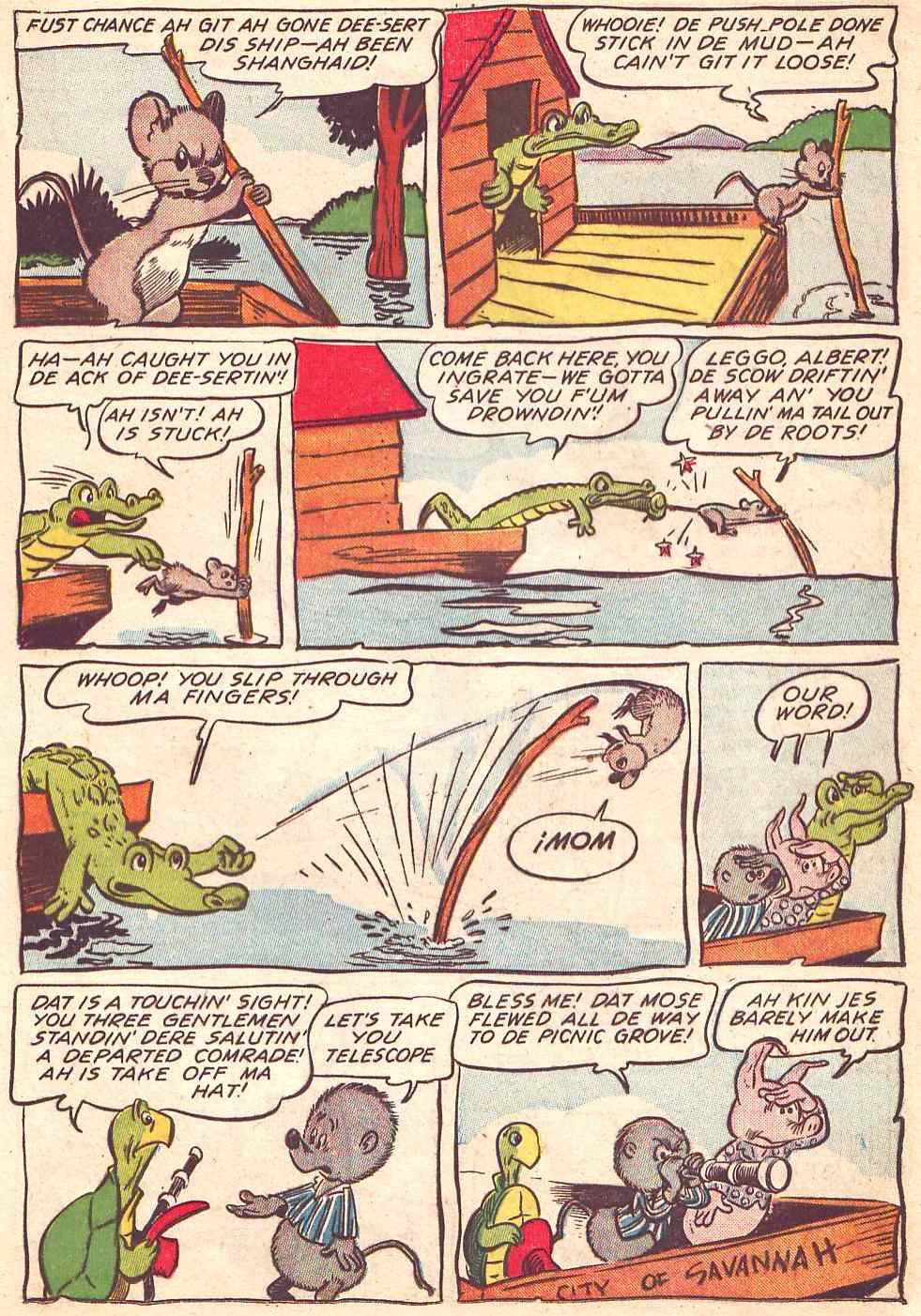


#24, December 1946–January 1947: Albert and Pogo

#25, February–March 1947: Albert and Pogo


#27, June–July 1947: Albert and Pogo


#29, October–November 1947: Albert and Pogo


… The lettering of Kelly’s Pogo Possum stories was farmed out, as so often had been the case with his earlier stories. Anne DeStefano wrote to Kelly in 1952 to tell him that Raymond Burley, a veteran illustrator for pulp magazines and early comic books, had lettered forty-six pages for no. 11, January-March 1953.[25] As before, the results, compared with lettering done by Kelly himself or under his direct supervision, were limp (the lettering is mostly italic) and all too uniform. George Ward said that Kelly was “very pleased” with Burley’s work, even though it seems clear that the expressive possibilities had been suppressed. …
The following pages are from Pogo Possum, #11, January-March 1953. This page from “The Worm’s Turn” has all the letters of the alphabet except X and Z.

This page from the same story has the letter Z.

The letter X is on this page from “Old Mudder Cupboard”.

Three pages of original art with Burley lettering, from Pogo Possum #1, October–December 1949, show the blue line sketches, lettering and guide lines: “The End of the Rainbow” page 37 and page 48; “The Great Two Gun Fiasco” page 9.
Heritage Auctions has original art pages, with Burley lettering, from the following Pogo Possum issues: #3, August–October 1950: “School for Mice” page 28 and page 29; “Feelin’ Mighty Hale, and Farewell” page 39 and page 40; #7, October–December 1951: “New Jag on the Old Bean Stalk” page 29 and page 31.
Advertising Age, July 4, 1949, said
New officers of the New York Advertising Men’s Post No. 209 of the American Legion, elected on June 20, were: Hugh Norman of Park & Tilford, commander, and Charles R. Bell of American Legion public relations department; Raymond A. Burley, De Bellis, Buoni & Cappo; C. Armond Johnson, Paper Sales Corp.; Glen Lemons, Advertising Novelties, and Warren Rohlfs, F. A. Russo, Inc., vice-commanders.
The 1950 census said Burley (line 2) continued to live at 200 West 16th Street. He was a commercial artist in advertising. Burley earned $4,450 the previous year.

Art Director & Studio News, August 1954, said
The Advertising Men’s Post 209, American Legion presented the Gray-Russo Annual Award for outstanding service to Raymond A. Burley, artist, 200 W. 16 Street, New York. Mr. Burley has served as artist, layout man, copywriter and editor of the Post’s monthly news-bulletin, Ad Poster.The award was founded four years ago in commemoration of James H. Gray, James Gray Inc., and Francis A. Russo, F. A. Russo, photographers.
A number of city directories are available at Ancestry.com. The 1960 Manhattan telephone directory listed Burley at 200 West 16th Street. In the mid-1960s he moved to San Diego. The 1965 San Diego directory listed Burley at 3730 Park Boulevard. The 1968 directory had two listings: “Raymond Burley”, vice-president, Southwestern Artists Association, 5981 Lauder Street; “Raymond A Burley”, retired, 3730 Park Boulevard.

Burley’s oil paintings were exhibited at the Southwestern Gallery in Balboa Park.

San Diego Union, August 14, 1966

San Diego Union, May 26, 1968
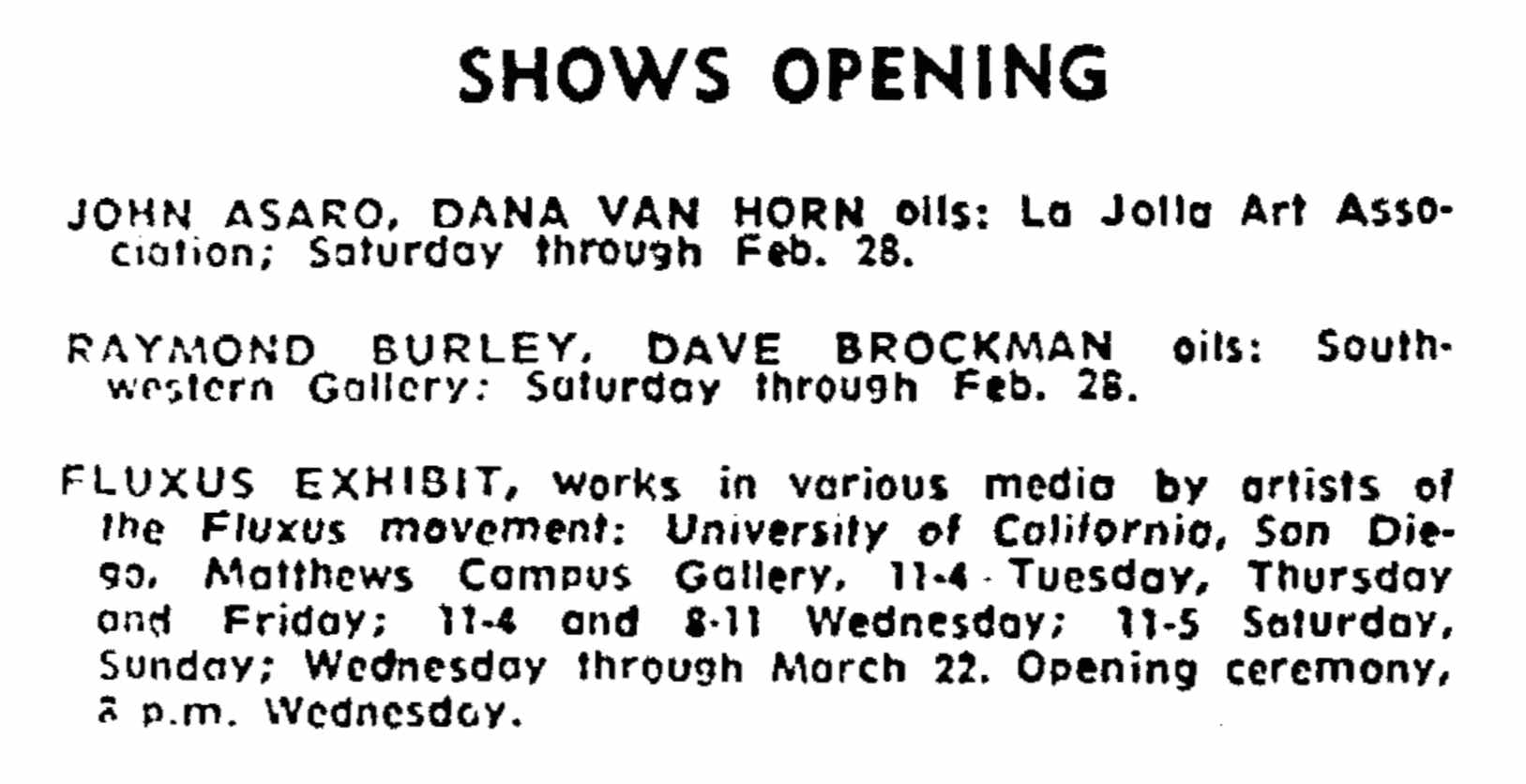
San Diego Union, February 9, 1969

San Diego Union, June 27, 1971
Burley passed away on October 4, 1971, in San Diego, California. He was laid to rest at Cypress View Mausoleum and Crematory.
Related Posts
A. Machine and Royal Cartoon, Mario Acquaviva, Al Allard, Gerald Altman, Gene Barnett, Vivian Berg, Daniel Bhang, John Bulthuis, Ray Burley, Ray Burzon,
Jean Callahan, Helen Chu aka Duffy Mohler, Milton Cohen, Ellen Cole, Herb Cooper, Danny Crespi, Laurens Crossley,
Gerda Gattel, Selma Meyers Gleit, Louis L. Goldklang, Angelo Grasso, Anita Greene, Al Grenet, Ed Hamilton, Delores Heilman, Ray Holloway, IBM Directory, Alex Jay, Albert and Charlotte Jetter,
Abe Kanegson, George Kapitan, Anna Kaufman, Gary Keller, Rick Keller, Nadine French King, Ralph Komisarow, Grace Kremer, Morrie Kuramoto, Al Kurzrok,
Bob Lander, Bob Laughlin, Bob Leatherbarrow, Shelly Leferman, Len Leone, Joe Letterese, Veda Lufkin,
Robert N. MacLeod/Leroy Lettering, Lee Maroshek, Larry Mayer, Ed McLean, Jack Meltzer, Mel Millar, Jim Novak, Bill Oakley, Ben Oda,
Walter Palais, Stephen Palmisano, Charles Paris, Otto Pirkola, Fred Proctor, Jerry Robinson, Joe and Sam Rosen, George Roussos,
Georgette Sauterel, Ira Schnapp, Irving Settel, Rome Siemon, Artie Simek, Lora Sprang aka Pat Gordon, Herman Stackel, Stan Starkman, Daisy Swayze, Zoltan and Terry Szenics,
(Next post on Monday: Original Designing Company)


