Showing posts with label Martin Goodman. Show all posts

Monday, November 18, 2024

Comics: Mel Blum, Art Director


Melvin Donald Blum was born on February 23, 1920 in Manhattan, New York City, according to the New York, New York Birth Index, at Ancestry.com, and the Social Security Death Index. However, his World War II draft card and marriage application had the birth date February 22, 1917. 

Blum was born six weeks after the 1920 United States Census enumeration. His parents, Sidney and Selma, and sisters, Dora and Sarah, were in the household of his paternal grandparents. They were Manhattan residents at 1646 Madison Avenue. Blum’s father was a dry goods salesman. 


The 1925 New York state census counted Blum, his parents and sister in the Bronx at 1635 University Avenue. His father was a printer. 


In the 1930 census, Blum, his parents, sister, Rita, and brother, Barry, lived in Brooklyn at 2207 East 4th Street. His father was a printing executive. 


Presumably Blum attended school in Brooklyn. It’s not clear if he had any formal art training. Apparently Blum’s father had some influence on his career direction. 

According to the 1940 census, Blum was an art director at a printing firm. He continued to live with his parents in Brooklyn at 1620 East 33rd Street. Blum was a high school graduate who earned $2,400 in 1939. 


Six months after the census enumeration, Blum signed his World War II draft card on October 10, 1940. His address was updated twice. Blum’s description was five feet nine inches, 175 pounds, with blue eyes and blonde hair. His employer was the A.J. Lipp Company, a printing firm in Manhattan. 


On March 21, 1941, Blum and Betty Shapiro obtained a Brooklyn marriage license. The application said he was a production manager. The couple married on April 6, 1941.


At the Timely-Atlas-Comics blog, Dr. Michael J. Vassallo interviewed Allen Bellman who explained that Blum sometimes used his brother’s name to be known as Mel Barry. Beginning in Fall 1942, Mel Barry was credited in Krazy Komics numbers 2 (associate editor) and 3 (technical advisor), and Terry-Toons issues 3, 5, 6, 8 and 9 (technical advisor). Mel Blum was technical advisor in Terry-Toons numbers 10, 11, 12, 49 and 51.  
 
Years later Blum became art director of Martin Goodman’s magazines and paperbacks. 


The 1950 census recorded the Blum family of four in Flower Hill, Nassau County, New York at 11 Greenway Street. Blum was art director at Magazine Management. He earned $1,700 in 1949 and did not serve during World War II. 


Writer’s Digest, March 1957, said Blum was the editor of Ken for Men. Journalism Quarterly, Summer 1958, published “The Social Anatomy of the Romance-Confession Cover Girl”. The footnote said Blum was one of the respondents to the research. 

At some point Blum was divorced. In 1960 he married Lorraine Setchen in Manhattan. 

Common Sense, February 15, 1960, published a Jewish Pornography Index that included three magazines art directed by Blum. 

At some point Blum left Goodman’s publishing empire and found work at the National Enquirer. It’s not clear when he started there. In 1971 the newspaper moved from New York to Lantana, Florida. The Working Press of the Nation, Volume 2 (1980) had an entry for the National Enquirer whose staff included Blum. 
National Enquirer
600 S.E. Coast Ave., Lantana, FL. 33464
Last Date Listing Updated Verified 01/79
National Enquirer
Phone: 305-586-1111
PBD: Weekly
Circulation: 5,719,918 (ABC) 
PG: 58 x 78 1/2 picas; COL: 11.3 picas; PHOTO: Yes; MAT; No, CUT: Yes; SCREEN: 65; CHARGE: Yes; PAY: Yes; RATE: Depends on material.
Generoso Pope, Jr. ..... Publisher
Iain Calder ..... Editor 
Paul Levy ..... Managing Editor 
Ralph Gallagher ..... Advertising Manager 
Malcolm Balfour, Mel Blum ..... Associate Editors
Ron Caylor, Raymond Villwock ..... Associate Editors 
Blum passed away on July 10, 2010. The Social Security Death Index said his last residence was Brooklyn. A paid death notice appeared in The New York Times, July 12, 2010. 
Blum—Mel. Loving father of Marilyn, Terry, Gene, Vicki, and Avi. Sibling to Barry and Rita.

Further Reading
Mens Pulp Mags, Andrew Nette: pulp fiction historian, novelist, blogger—and real cool cat 
Horrorhound #30, July/August 2011, “World of Vintage Men’s Adventure Magazines” (Blum not mentioned)


(Next post on Monday: Ark Interiors Logo)

Monday, January 16, 2023

Comics: Hank Chapman and Bonnie Hano’s Marriage, an Amazing Fantasy

Alter Ego #18, October 2002 published Jim Amash’s interview with Stan Goldberg who said Hank Chapman married Bonnie Hano (see page 12). Did they really marry each other? 

An excellent article, by Ger Apeldoorn, about Hank Chapman is at The Comics Detective website. It was posted in 2010. Bonnie Hano has a brief profile at Women in Comics Wiki. She passed away in April 2022. Here’s additional information about Chapman and Hano to help answer the question.

Henry Peter Chapman was born Henry Csepielewski on May 3, 1915, in Utica, New York, according to the New York State Birth Index at Ancestry.com.


Over the decades, there were various spellings of Chapman’s birth surname.

The 1915 New York state census said Chapman was the youngest of two sons born to Martin and Adeline Ciapaskely, both Russian immigrants. They lived in Utica at 47 Cottage Place. His father was a shoemaker.


The 1920 United States Census recorded the Cypel family in Utica at 1217 Lincoln Avenue. It’s not clear if they were related to Cypel family preceding them. 


According to the 1925 New York state census, Chapman, his mother, brother and sister were Utica residents at 610 Cottage Place. The status of his father is not known. Their surname was spelled Ciepolowski. 

Chapman’s mother and brother were listed on the previous sheet. 

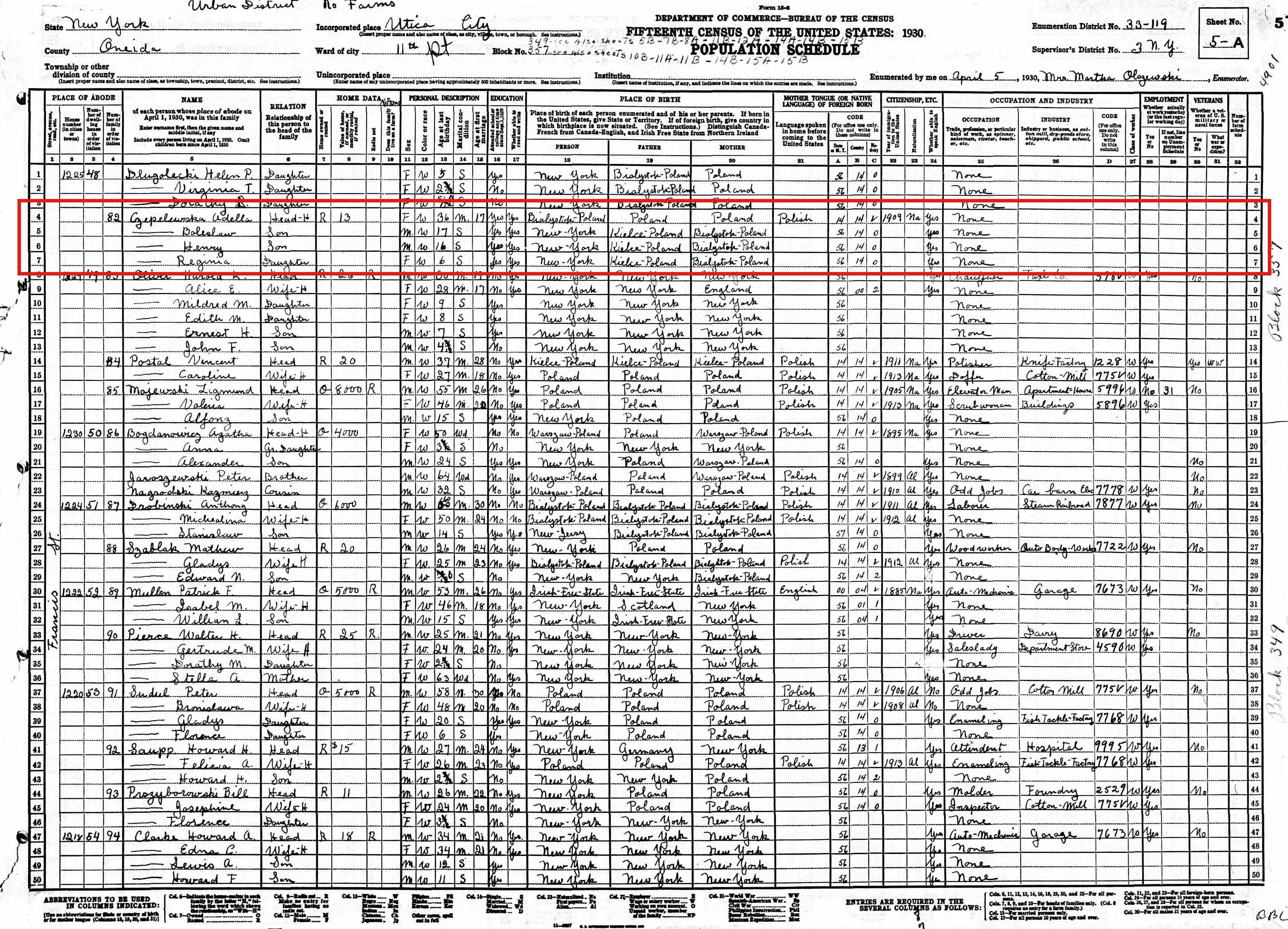
The 1930 census recorded the Czepelewska family in Utica at 1225 Francis Street. Hano makes her first appearance in this census. 


Bonnie Hano was born Bonnie Abraham on September 12, 1926 in Sioux City, Iowa, according to the Iowa Birth Index at Ancestry.com. Her parents were Leon Abraham and Rose Gelfand (not Gelfund), both Romanian immigrants.


In the 1930 census, Hano was the youngest of two sisters. They were Sioux City residents at 213 West Second Street. Her father was a presser at a dry cleaner.


According to the 1940 census, the Abrahams were in Sioux City at 1117 West 11th Street. 


In Utica, the census counted the Chepman family at 430 Mandeville Street. Chapman worked as a weaver at a cotton mill.  


In the early 1940s, Chapman signed his World War II draft card. His address was the same. His mother’s surname was spelled Cepelewski. Chapman’s description was six feet, 170 pounds, with brown eyes and hair. Chapman was a photographer when he enlisted on January 3, 1942 in the Army Air Corps. His veteran’s files said he was discharged on September 19, 1945.


Chapman got his training in Sarasota, Florida. He wrote for the U.S. Army Air Corps Field News newspaper that was printed in the Sarasota Herald-Tribune. Below is a page with five articles and a poem by Chapman. 


The Service Men’s Club column in the Sarasota Herald-Tribune, November 30, 1943, said
Now that the Christmas season is so near we at the Service Men’s club are beginning to get cards and letters from our boys and girls from all points of the compass.

Today we receive the Christmas card gotten out by the “ol’ 97th Bombardment Group”, from S/Sgt. Henry P. Chapman, 12044277, Headquarters, 97 Bombardment Group, APO 520, New York city. Says Sgt. Chapman: “Africa, Yuletide Greetings, the name Sarasota will always be synonymous with unselfishness, kindness and munificence to us of the “ol’ 97th.”
While Chapman was serving in the European Theater, Hano was in high school and graduated in 1944 from Sioux City’s Central High School.

Bonnie Abraham
1944 Maroon and White yearbook

At some point, Hano and Chapman moved to New York City. When they met at the Timely/Atlas office, they were married but not to each other. 

On January 19, 1946, Bonnie Abraham and Jack Herman (not the person at Who’s Who of American Comic Books 1928–1999) obtained Brooklyn marriage license number 1491 and married that day. She used her maiden name so I believe this was her first marriage. This is notable because she was Bonnie Herman in her marriage to Arnold Hano.


Almost six months later on June 15, 1946, Chapman and Gloria F. Brady obtained Bronx marriage license number 6817. They married on or shortly after that date. The New York City marriage register for Chapman is below; the actual license and certificate are not yet available.


Based on the following timeline Chapman and Hano were never husband and wife.

Chapman enlists January 1942; serves in Europe.
Hano graduates June 1944.
Chapman discharged September 1945.
Hano marries January 1946.
Chapman marries June 1946.

The time frame was too tight for Chapman and Hano to have married and divorced. And there’s no New York record of their marriage. The Jack Kirby Collector #69, Fall 2016, published David Laurence Wilson’s interview with Hano and her husband. Here’s what she said. 
Do you know what’s so crazy? I looked up something one day, and I found on the Internet that I was Hank Chapman’s first wife. I don’t know where they ever got that. When I met Hank, he was married to Gloria, whom he called Toni, and we knew her as Toni. They became very good friends of ours. So how did I get married to Hank on the Internet? How do things like that happen? 
Stan Goldberg’s claim about their marriage had spread far and wide in books, magazines and websites.

In the 1950 census, Chapman and Gloria were residing in Queens, New York at 67-38 108th Street. He was an editor at a comic book publishing company. Hano and Jack have not yet been found. 


In the late 1940s, Hano was working for publisher Martin Goodman at Magazine Management. The 1950 Literary Market Place listed Hano as associate editor Bonnie Herman at Lion Books, Inc., and the rest of the staff that included Arnold Hano, the editor. 


They married in Greenwich, Connecticut on June 30, 1951. (In 1950 or 1951, Arnold Hano’s 1942 marriage to Marjorie Adele Mosheim ended in divorce. They had a son and daughter.)


Hano left Lion to work at Timely and assist Stan Lee who wrote a poem to her. When Chapman left Timely, Hano took over his job as production manager. 

In 1952, Hano and her husband lived at 124 East 24th Street in Manhattan. Both were members of the American Labor Party. Their address, in 1953, was 230 West 105th Street. 

Under the pseudonyms Matthew Gant and Mike Heller, Hano wrote Valley of Angry Men (1953), So I’m a Heel (1957), and The Manhunter (1957). 

... In 1955, Arnold Hano moved with his wife Bonnie and their daughter Laurel to Laguna Beach, California. 
Desert Magazine, February 1959, said
After a New Mexico vacation in 1952, free lance writer and photographer Henry P. Chapman quit his editorial staff job with a New York publishing house and moved West. Today an adobe in Tesuque is his home and office, and the Indians of the Tesuque Pueblo his neighbors.

Henry and his wife, Toni, have “prospected for facts and photos all over the world and in most of the 49 United States.” His article in this month’s Desert, “Rockhounding with a Camera,” tells how they gather “treasure” in the Southwest.
Chapman passed away on October 18, 1973, in New Mexico. He was laid to rest at the Santa Fe National Cemetery. A brief obituary appeared in the Santa Fe New Mexican, October 19, 1973. 
Chapman, Henry P. 58—Passed away at his home in Tesuque, Thursday afternoon following a sudden illness, veteran of World War II and a resident of Santa Fe area for the last twenty years. Survived by wife Toni. Arrangements to be announced later through Memorial Chapel. 
Hano passed away on April 18, 2022. Four days later a long obituary appeared in the Laguna Beach Independent. 


Further Reading
Grand Comics Database has a checklist of Chapman’s work.
American Legion, January 1960, “The Day I Died!” by Chapman.  The story was reprinted in Military Intelligence: Its Heroes and Legends (1987) 
Desert Magazine, various issues with Chapman’s articles, photographs or just a mention 

Savage Art: A Biography of Jim Thompson (1995), Bonnie Hano was a family therapist.
Timely-Atlas-Comics, Martin Goodman: The Marilyn Monroe Covers, Articles and Photo Features; Arnold Hano was editor of Focus. 
Laguna Beach Independent, March 17, 2022, Laguna Beach offers fond farewell to Arnold Hano 
Time, August 15, 1955, a review of Arnold Hano’s A Day in the Bleachers


Women in Comics Posts


Monday, April 12, 2021

Comics: A Timely Move Begets a Timely Name


Martin Goodman was the owner of Timely Comics which became Marvel Comics. The Wikipedia profile of Goodman charts his business locations from Lower Manhattan to Midtown Manhattan. Goodman’s business addresses are mentioned in the profile of Lincoln Hoffman at Field Guide to Wild American Pulp Artists. 

Goodman moved from the RKO Building [at Rockefeller Center] to the McGraw-Hill Building (at 330 West 42nd Street) on April 15, 1939 (sourced from a Writer’s Digest issue by comic-book historian Will Murray) where Timely had their offices until the move in 1943 onto the 14th floor of the Empire State Building.
At the McGraw-Hill Building Goodman launched several publications. Michael J. Vassallo, in his blog Timely-Atlas-Comics, explained when Timely was first used. 
... [In 1939] Goodman mimicked the successful Reader’s Digest format with his own Popular Digest, a collection of condensed and already printed articles, but that experiment ended in failure. ... There is an important comic book connection to Popular Digest because the sub-publisher for the releases was Timely Publications, the very first time Goodman ever used the word Timely and the only non-comics title to do so. The interior sub-title was even “Timely Topics Condensed”. The first issue was dated September 1939, one month before the publication of Marvel Comics #1 (Oct/39). So Goodman got both his comics company name/brand and the sub-publishing entity for his comic book debuts from Popular Digest. ... 
Why did Goodman choose the name Timely? Perhaps he was influenced by the McGraw-Hill publication Timely Ideas. McGraw-Hill occupied over half of the space in its building. In the lobby there may have been a display of McGraw-Hill publications. Maybe Goodman was on the same floor as Timely Ideas. Whatever the case, I think it’s likely Goodman was aware the magazine title. 

Timely Ideas was a technical magazine aimed at operators of electric equipment. I don’t know when the magazine debuted but it was published as early as 1936. Who’s Who in Engineering, Volume 7 (1954) said Rue Miller Shoop was the managing editor of Timely Ideas from 1936 to 1939. The January 29, 1938 issue of Electrical World (a McGraw-Hill publication) published an advertisement with the Timely Ideas logo. 


Electrical World, April 11, 1936


Electrical World, November 20, 1937


Electrical World, January 29, 1938


Another Timely Ideas staff member was Louis James Dennis who signed his World War II draft card on October 16, 1940.


Timely Ideas was mentioned in the magazine Electronics, October 1941, “Photoelectric Door Opener Saves $30 Per Day”. Timely Ideas was an established trade publication. 

A remote possibility is Goodman got the Timely name from Timely Topics, first published in 1897.


When Goodman chose the Timely name he was in the right place at the right time. 


(Updated October 16, 2021; next post on Monday: Wolfpack)