For a number of years Charlton Comics used typefaces, instead of hand-lettering, in word balloons and captions on many of its titles. A page of art was inserted in the typewriter carriage and text was typed on the page.
According to Charlton Comics: The Movie, the first custom-typeface, which was designed to mimic hand-lettering, debuted in My Secret Life #27, February 1959 and probably on newsstands in late 1958. “The Schemer” used both typeface and hand-lettering. (Pat Masulli was editor at the time.)


This typeface gradually spread to other titles with a May cover date including: My Secret Life #28, here and here; Rocky Lane’s Black Jack #27, here and here; and Romantic Secrets #21, all stories. Over the months and years, the typeface was used in more titles but had not completely replaced hand-lettering.
Evidently a second typeface debuted in 1967. In Thunderbolt #57, May 1967, The Sensational Sentinels story was “lettered” by A. Machine. The A. Machine typefaces came in roman and italic versions and were very different than the first typeface. (Dick Giordano was editor at the time.)


Catspaw Dynamics said the A. Machine typefaces were from VariTyper, a subsidiary of the Addressograph-Multigraph Corporation. The cover original art for Attack #60, November 1959 was shown as an example. Below is the printed cover.

The cover text is actually the first typeface which, in fact, was manufactured by the Royal Typewriter Company. The typeface, one of several from Royal, was in the 1964 National Office Machine Dealers Association Blue Book. It was named Cartoon and available to the public. (The first typeface to be called Cartoon, also known as Fresko, was created in 1936 by Howard Allen Trafton.)

Not to be outdone, VariTyper produced its versions of Cartoon (here and here) as shown in VariTyper Typefaces: A Guide to Better Typography (1965; Revised Edition, 1967). The designer is unknown. (Operating a VariTyper is explained here.)


Who designed Charlton’s Cartoon typeface?
Comic Book Artist #9, August 2000, published an interview with Frank McLaughlin who said
Pat Masulli designed a comic typeface for a large typewriter. … The comic pages would fit in the typewriter and the copy would be typed right on the artwork. The results were a complete disaster that caused many more problems than it solved. It was a typical attempt to cut corners but the finished product suffered greatly.
The Royal typewriters (non-electric and electric) produced letters, numbers and punctuation on a grid, like a crossword puzzle, so the letterspacing was uneven in some words.

Royal non-electric typewriter with an extra-long carriage

Left: Royal Cartoon, Captain Atom #75, June 1966. Right: A. Machine, Thunderbolt #58, July 1967
Masulli has no lettering credits at the Grand Comics Database (GCD). Lettering was probably part of Masulli’s skill set since he was an artist, inker and colorist. The lettering in “Crush” (also from My Secret Life #27) resembles the Royal Cartoon typeface particularly in the V, W, Y, skinny U, and slanted exclamation point.

Two panels each of hand-lettering (left) and Royal Cartoon typeface (right)
The Royal Cartoon typeface may have been based on lettering by Masulli or someone else, possibly Jon D’Agostino (profiled here). It’s not known who taught lettering to D’Agostino who would have been influenced, to some degree, by the unknown letterer’s style. It’s not clear when D’Agostino started lettering for Charlton. The GCD suggests he started in 1953. The Charlton Companion (2022) said D’Agostino contributed beginning in 1955. The GCD credits D’Agostino on these two comics.

Lawbreakers Suspense Stories #12, May 1953, page 6

As you can see, the lettering styles are different. Two persons did the lettering but which one was by D’Agostino? Here are two credited pages of D’Agostino’s lettering from the 1960s.

The Amazing Spider-Man #1, March 1963, page 5

Here are panels from Rocky Lane Western #77 (left) and Amazing Spider-Man #1 (right).


I will go out on a limb and suggest D’Agostino’s lettering evolved over time. He aspired to be an artist (here and here) but started as a colorist and, at some point, added lettering as another skill and source of income. There are similarities in the construction of several letters in the above samples. The top of the letter J has a cross bar which some letterers didn’t add. Most of the Rs have a flat top. The Ys are basically the same. The skinny U is in both. The exclamation points are slanted. One noticeable difference is the Ws. (The odd-shaped W was acceptable at Charlton but unacceptable at other publishers. I can imagine an editor, artist or letterer telling D’Agostino to fix the W in order to get lettering assignments.) Even though Frank McLaughlin credited the Royal Cartoon typeface design to Masulli, I think D’Agostino designed the alphabet for Masulli who was busy with editorial chores. This development reduced the number of lettering assignments available to D’Agostino and others and forced them to look elsewhere.
In a few pre-1967 Charlton Comics, the GCD credits A. Machine for the lettering. It’s important to distinguish between the two, very different, typefaces even though both were “lettered” with Royal typewriters.
Comic Book Artist #9, August 2000, published an interview with Dick Giordano who talked about Charlton’s second Royal custom-typeface which replaced Royal Cartoon.
… We got “A. Machine,” a Royal typewriter with an 18-inch carriage—that’s when we had 12-inch paper, plus the little edges on it—and we used to type on the lettering. We had customized letters made for this Royal electric.… We used to run the pages right into the machine. Two-ply paper, and type right on the paper. It wasn’t pasted up. [laughter] Royal developed a special ribbon, you could only use it once. When the key hit the paper, it would put a lot of ink on the page, and it’d leave a white spot on the tape, and after you took the page out, you basically had to let it dry for a while. That ink might smudge. My wife ended up being the typist. The stories with lettering credited to “A. Machine” are basically my wife. I got Charlton to send the machine up to my house, after we got it working and I showed her how to do it.
The designer of the Royal custom-typeface for A. Machine is unknown. The typeface appeared in more titles but failed to replace hand-lettering. Giordano didn’t reveal the page rate for typing. Maybe one day, someone will tally the number of pages lettered by A. Machine and assess its impact on Charlton’s bottom line.
Two pages from Blue Beetle #1, June 1967


SIDEBAR: A Few Details About Pat Masulli
Patrick Joseph “Pat” Masulli was born on July 31, 1930 according to the New York New York Birth Index and his Social Security application, both at Ancestry.com. His National Guard service card had the year 1929. The 1940 United States Census recorded Masulli (line 49) as the only child of Charles and Ann (Baratta). They lived in the Bronx at 841 East 227th Street. His father was a painter for a contractor.

On December 12, 1946, Masulli enlisted in the National Guard. His address was 680 East 224th Street in the Bronx. He was assigned to Company I, 8th Infantry.
Masulli graduated, in 1947, from DeWitt Clinton High School.

Who’s Who of American Comic Books 1928–1999 approximated his comics career beginning in the second half of the 1940s. He continued his art training at the Cartoonists and Illustrators School and Phoenix Art Institute.
According to the 1950 census, self-employed Masulli (line 18) lived with his parents at 680 East 224th Street in the Bronx. His occupation was “color cartoons” for “children’s funny books”.


Daily Argus (Mount Vernon, New York), November 1, 1950
In the Comics Buyer’s Guide #1305, November 20, 1998 was an article about Charlton Comics that said
… In 1952 a promising young artist named Dick Giordano was making his way into the annals of comic-book history. Giordano began freelancing for Charlton around New Year’s Day of 1952 for Al Fago, the publishing house’s first editor, and was living in New York in the Bronx at the time. In 1955, Charlton’s owner decided he wanted all employees working for the company to work onsite in the suburbs of Derby, Conn., and Giordano began a run of 10 years as a staff penciller and inker. From 1959 to 1960 he worked as assistant to then-Executive Editor Pat Masulli. “Pat started there the same time that I did,” said Giordano, “He was a colorist at the time. He became the executive editor for the company after Al Fago left to pursue other interests.”
It’s not known when Masulli enlisted during the Korean War. A 1952 Bronx voter register said Masulli resided at 680 East 224th Street and was a military voter (MV). At some point Masulli was stationed at Fort Lee in Virginia where he was an usher at the wedding of Sergeant Joseph John Orlando (not the artist), also of Fort Lee, and son of Mr. and Mrs. Frank Amuso, of the Bronx (Richmond Times-Dispatch, May 5, 1953).
On October 14, 1953, Masulli and Jacqueline Fern Salerno were married in Petersburg, Virginia.

The New York, New York Marriage License Index, at Ancestry.com, said the couple, in 1954, obtained license number 2132 in Manhattan. Perhaps the second ceremony was for their parents, relatives and friends.
In New York City, Masulli assisted editor Al Fago who packaged comics for Charlton and others. Masulli became editor when Fago left in 1957. Masulli’s assistants were Giordano followed by Frank McLaughlin. In The Charlton Companion (2022), Giordano recalled carpooling and commuting to Charlton, beginning in Spring 1955, before moving to Derby in 1957.
Since I was working there and commuting back and forth, carpooling with four others, my wife and I decided, driving 65 miles just to get to work and then back again was ridiculous. This was before [U.S.] Interstate 95 [highway] was completed, so the only way to get up there was by the Merritt Parkway. We made our home in Derby in ’57.” With a chuckle, he added, “Our carpool was originally five people: Pat Masulli, Jon D’Agostino (a letterer then who is now one of the top artists at Archie), Sal Trapani (my brother-in-law), Vince Alascia, and myself—sounds like a carload of Mafioso, doesn’t it?
Eventually, Masulli moved to Connecticut to work at Charlton’s headquarters.
The splash page of Sarge Steel #1, December 1964, said Masulli created the character. In Superhero Comics: The Illustrated History (1991) Mike Benton said Masulli created Son of Vulcan.
In 1966 Masulli left the comics department and devoted his time to Charlton’s magazines. Masulli was quoted in Magazines in Search of an Audience: A Guide to Starting New Magazines (1969).
Patrick J. Masulli, executive editor of Charlton Publishing Corp. suggests that new magazines can be predicted “largely on trends which can sometimes be noticed in television and motion pictures. Advertising agencies because of their tremendous financial resources spend millions of dollars in motivation research and audience response. Publishers try to use the results of their findings to observe what is being produced and what proves to be successful.”... Patrick Masulli, too, cautions the new publisher to “know the rules of good publishing. Above all, know what kind of distribution you can expect, and what kind of treatment the distributor will give you. A poor distributor can kill a magazine but a good distributor, through the proper use of controlled allotments to wholesalers and using his fieldmen, can squeeze out the last possible sale and sometimes carry an otherwise weak magazine through the first, most dangerous year of publication.”
The 1967 New Haven, Connecticut city directory listed editor Masulli at 285 Greene Street, apartment G2.
Public Records Index, at Ancestry.com, listed Masulli’s early 1990s address as 358 Fairwood Road, Bethany, Connecticut.
Masulli passed away on June 10, 1998, in Bethany.
SIDEBAR: A Few Details About Al Fago
Alfred Vincent “Al” Fago was born on January 19, 1905, in Naples, Italy according to his World War II draft card. More Heroes of the Comics (2016) said he was born in Yonkers, New York.
The 1910 United States Census recorded Fago (line 62) as the second of four children born to Pasquale and Ersilia, both Italian immigrants. The family were residents of Yonkers at 165 Waverly Street. His father painted houses.

According to the 1915 New York state census, the Fagos gained another son, four-month-old Vincent (line 17). They lived in Yonkers at 139 Waverly Street.

The 1920 census said Fago (line 3) was a bookkeeper. He lived with his parents at the same address.

The 1925 New York state census said the Fagos (lines 44 to 50) lived in Bronx at 771 Grote Street (less than a block from the Bronx Zoo). Fago was a designer.

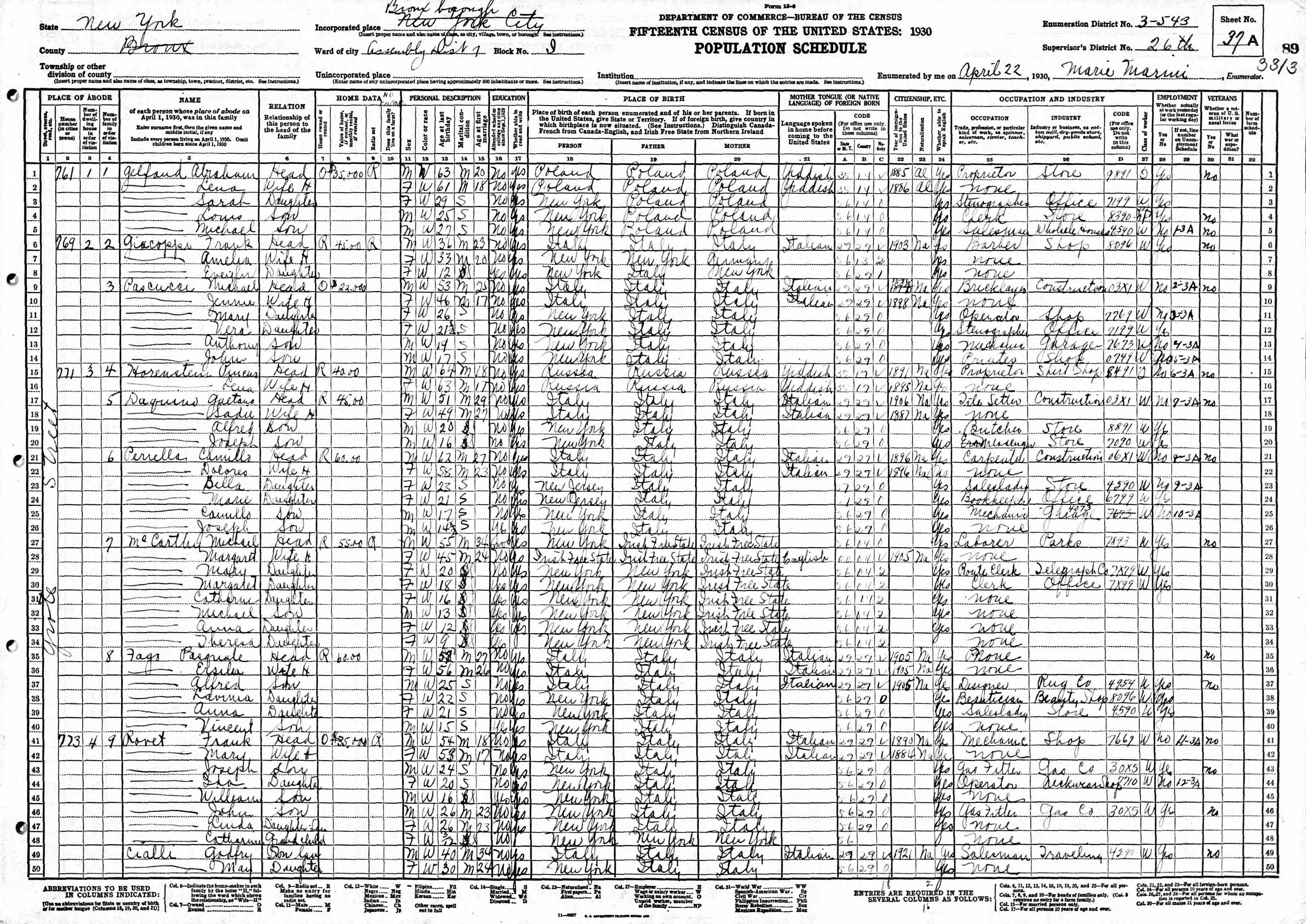
The address was the same in the 1930 census. Fago (line 37) was a rug designer.
On July 27, 1934, Fago and Josephine Pilone obtained, in the Bronx, marriage license number 5998. They married the next day.


The Official Gazette of the United States Patent Office, August 20, 1935, published Fago’s design for a rug.
The 1940 census said Fago (line 30), his wife and four-month-old daughter resided in the Bronx at 2962 Decatur Avenue. He was an industrial designer who earned $3,000 in 1939. His highest level of education was the fourth year of high school.

On October 16, 1940, Fago signed his World War II draft card. His employer was the Bigelow-Sanford Carpet Company in Manhattan. Fago’s description was five feet eight inches, 153 pounds, with brown eyes and black hair.

In the 1950 census, Fago was married to Bronx-born Blanche who had two daughters from her previous marriage. Her husband, whom she married in 1932, died on November 24, 1943 in Kansas City, Missouri (death certificate transcription at Ancestry.com). The status of Fago’s first wife is unknown. The family of five lived in Thomaston, Long Island, New York at 3 Susquehanna Avenue. Fago was a commercial artist at a studio. In Alter Ego #66, March 2007, Fago’s wife was interviewed. Blanche said “Alfred V. Fago Studios … was on 55 West 42 Street in New York. He did lots of humor work for a lot of places. He started at Charlton in 1952.” An overview of his comics career is at Who’s Who of American Comic Books 1928–1999.


The 1956 and 1957 Milford, Connecticut city directories listed Fago as an art director in Derby, Connecticut. He lived at 419 Butternut Court. Fago left Charlton in 1957. He was an art director in the 1959 directory. In the 1960 directory, Fago had the same address and was president and treasurer of Copystat of Connecticut which was located on Old Tavern Road.
The Official Gazette of the United States Patent Office, September 10, 1963, published Fago’s color separation patent.
Fago passed away on February 19, 1975, in Milford, Connecticut according to the Connecticut Death Index at Ancestry.com. His wife passed away on February 23, 2013.
Related Posts
A. Machine and Royal Cartoon, Mario Acquaviva, Al Allard, Gerald Altman, Gene Barnett, Vivian Berg, Daniel Bhang, John Bulthuis, Ray Burley, Ray Burzon,
Jean Callahan, Helen Chu aka Duffy Mohler, Milton Cohen, Ellen Cole, Herb Cooper, Danny Crespi, Laurens Crossley,
Gerda Gattel, Selma Meyers Gleit, Louis L. Goldklang, Angelo Grasso, Anita Greene, Al Grenet, Ed Hamilton, Delores Heilman, Ray Holloway, IBM Directory, Alex Jay, Albert and Charlotte Jetter,
Abe Kanegson, George Kapitan, Anna Kaufman, Gary Keller, Rick Keller, Nadine French King, Ralph Komisarow, Grace Kremer, Morrie Kuramoto, Al Kurzrok,
Bob Lander, Bob Laughlin, Bob Leatherbarrow, Shelly Leferman, Len Leone, Joe Letterese, Veda Lufkin,
Robert N. MacLeod/Leroy Lettering, Lee Maroshek, Larry Mayer, Ed McLean, Jack Meltzer, Mel Millar, Jim Novak, Bill Oakley, Ben Oda,
Walter Palais, Stephen Palmisano, Charles Paris, Otto Pirkola, Fred Proctor, Jerry Robinson, Joe and Sam Rosen, George Roussos,
Georgette Sauterel, Ira Schnapp, Irving Settel, Rome Siemon, Artie Simek, Lora Sprang aka Pat Gordon, Herman Stackel, Stan Starkman, Daisy Swayze, Zoltan and Terry Szenics,


