Monday, July 27, 2020

Comics: Herb Cooper, Letterer


Herbert Arthur “Herb” Cooper was born on February 16, 1927, in Manhattan, New York, New York, according to his World War II draft card which had his full name. However, his obituary in the Central New Jersey Home News (New Brunswick, New Jersey), April 24, 1991, said Brooklyn was his birthplace.

Cooper and his family have not yet been found in the 1930 U.S. Federal Census.

The 1940 census recorded Cooper as the third of four children born to Benjamin and Sarah, both Russian emigrants. His father was a clerk at a men’s clothing store.


Home News said Cooper attended the Mannes School of Music in New York City. At some point he studied lettering and calligraphy and joined the International Society of Scribes.

Cooper enlisted in the Army on December 19, 1945 at Greensboro, North Carolina. At the time his occupation was in the category of hotel and restaurant managers. His description was five feet five inches, 135 pounds, with green eyes and brown hair. Home News said Cooper was “an Army Air Corps veteran of World War II, … served in Special Services Ernie Pyle Theatre and in cryptography services.” Cooper’s veteran’s file said he was discharged December 24, 1946. Cooper’s address was 601 Kosciusko Street in Brooklyn where his parents lived.

On April 7, 1951, Cooper and Marilyn Rapport obtained a marriage license in Queens, New York.

Who’s Who of American Comic Books 1928–1999 estimates Cooper’s lettering career began in the 1950s at Marvel Comics. In 1968 Cooper’s name appeared on splash pages.


In Alter Ego #49, June 2005, Jim Amash interviewed Carl Burgos’ daughter, Susan, who said
… family and friends were invited over to the house. I remember Stan Starkman, George Kapitan, and Herbie Cooper from Timely Comics coming to visit. …

George Kapitan was a real sweetheart, as was his wife, Rose. Stan and Suzie Starkman, and Herbie and Marilyn Cooper would come over, too. I know George and Herbie aren’t with us any longer. I liked those guys, and they were a charming group, but my dad didn’t mix his kids with his friends. We’d come out and say, “Hi,” and then go back into our rooms. [laughs] …
In Alter Ego #134, July 2015, Richard J. Arndt interviewed Stan Goldberg who said
… Socially we’d go out and do stuff together [in earlier years]. Stan and his wife, Carl Burgos and his wife, Stan Starkman—he was a letterer who went to DC, and Herbie Cooper, another letterer who formed his own printing company. These were all guys from the old bullpens. We’d go out every month, go to dinner or the theater. We’d meet in the city for a Sunday brunch. It was a whole group of people that we stayed close with. …
Cooper passed away April 23, 1991, at his home in Fords, Woodbridge Township, New Jersey. Below is his obituary.
Herbert Cooper, 64
Woodbridge—Herbert A. Cooper died yesterday at his home in the Fords section. He was 64. He was born in Brooklyn and lived in Fords for the past 31 years. Mr. Cooper was a self-employed calligrapher for 40 years before retiring in 1990. He attended the Mannes School of Music in New York City and was a member of the International Society of Scribes. He was an actor with the East Brunswick Community Theater, where he played many leading roles. Mr. Cooper also acted in many off-Broadway productions. An Army Air Corps veteran of World War II, he served in Special Services Ernie Pyle Theatre and in cryptography services.

Surviving are his wife, Marilyn Rapport Cooper, three daughters, Wendy Fitzgerald of Edison, Laurie Keller of Iselin and Cara Peterson of Fords; a son, David S. of Woodbridge; a brother, Abraham of East Brunswick; a sister, Ethel Cooper of Brooklyn, and a granddaughter.

Services will be today at 1:30 p.m. from Flynn & Son Funeral Home, 23 Ford Ave., Fords. Burial will be at Beth Israel Memorial Park in Woodbridge.

Related Posts


(Next post on Monday: Walk Like an Egyptian)

Monday, July 20, 2020

Alphabets: Push Pin Studio in the Alphabet Thesaurus, Volume 3

Alphabet Thesaurus, Volume 3
Photo-Lettering, Inc.
Alphabet designer credits are from the index.

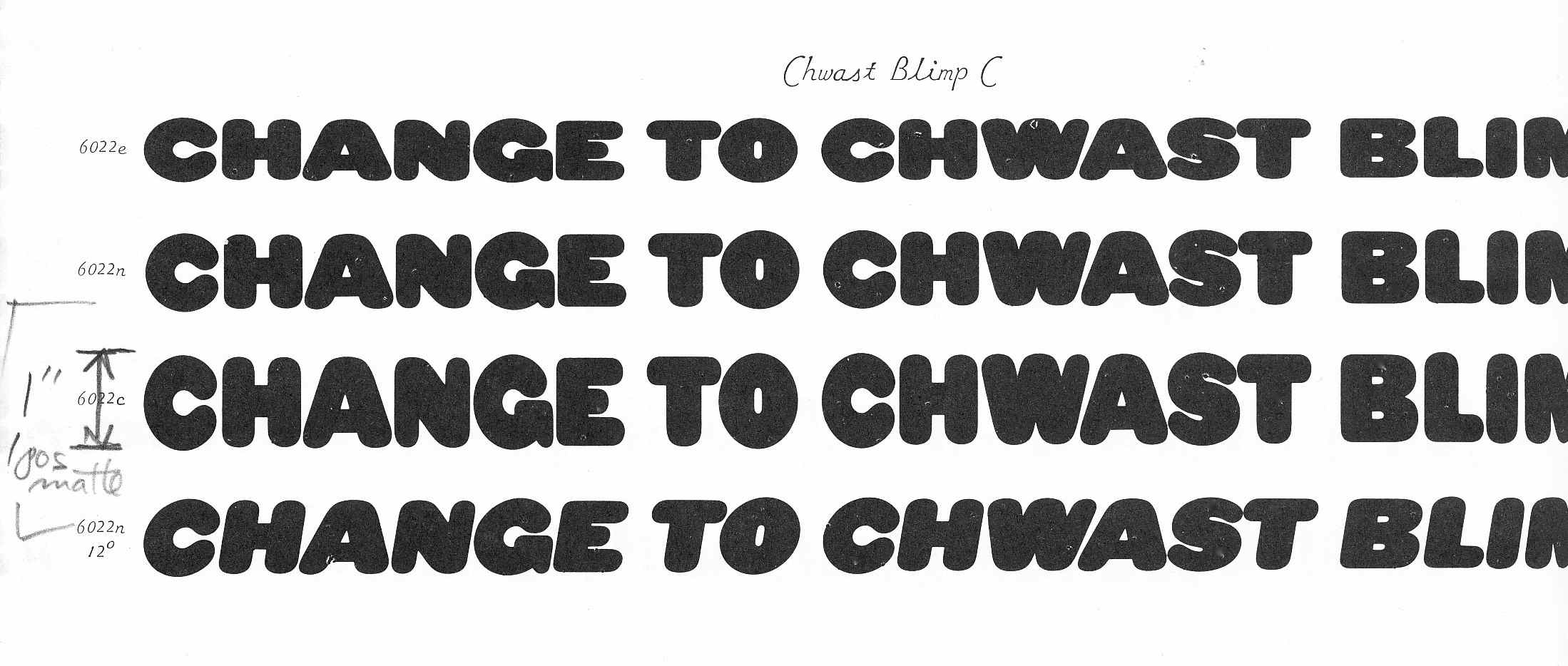
Page 120: Blimp
by Seymour Chwast
Seymour Chwast: The Left-Handed Designer (1985), page 132: Chwast said Blimp was based on a wood type font.


Page 396: Push Pin Art Deco
by Milton Glaser and Seymour Chwast


Page 400: Filmsense
by Milton Glaser and Seymour Chwast
Seymour Chwast: The Left-Handed Designer (1985), page 132: Chwast said Filmsense was the logo for the studio’s film division, and based on Glaser’s letterhead for the studio.


Page 409: Baby Teeth
Milton Glaser Graphic Design (1973), page 164: Glaser said the inspiration for Baby Teeth was a tailor’s sign in Mexico City.


Pages 414 and 415: Babyfat
Milton Glaser Graphic Design (1973), page 160: Glaser said Babyfat was his first alphabet design.


Pages 420 and 421: Eightway
by Milton Glaser and George B. Leavitt


Page 422: Houdini
by Milton Glaser and Seymour Chwast
Milton Glaser Graphic Design (1973), page 166: Glaser said he wanted to create a letterform that gradually disappeared as a line was removed.


Page 423: Push Pin Myopic
by Milton Glaser and Seymour Chwast
Seymour Chwast: The Left-Handed Designer (1985), page 132: Chwast said the alphabet could have an infinite number of drop shadows.


Page 431: Artone
by Seymour Chwast
Seymour Chwast: The Left-Handed Designer (1985), page 132: Chwast said Artone began as a trademark, a lowercase A (below, lid and front of box for 32 ounce bottle). Then he developed an alphabet based on Art Nouveau.


Related Posts


(Next post on Monday: Herb Cooper, Letterer)

Saturday, July 4, 2020

Monday, June 29, 2020

Comics: Mario Acquaviva, Letterer and Artist


Mario Ciro Acquaviva was born on May 2, 1917, in Manhattan, New York City, according to the New York, New York Birth Index at Ancestry.com. His middle name was on his Social Security application. In December 1936 the application had Mauris as the middle name. It was changed to Ciro on October 16, 1979. The application also named his parents, Alfredo Acquaviva and Antoinetta Piccirillo, both Italian emigrants.

The 1920 U.S. Federal Census recorded Acquaviva, his parents and younger sister, Concetta, in Manhattan at 250 Mott Street. His father was a jeweler in novelties.

According to the 1925 New York state census, the Acquaviva family of five resided in the borough of Queens in Long Island City at 464 Vernon Avenue.

The Acquaviva family numbered six in the 1930 census. They were Bronx residents at 632 East 186 Street.

Information about Acquaviva’s art training has not been found.

In the 1940 census Acquaviva was an artist in the Work Projects Administration. He was living with his parents in the Bronx at 2323 Cambreleng Avenue. The census said he had four years of high school and none in college. In 1939 he earned $1,092.

On October 16, 1940 Acquaviva signed his World War II draft card. His address was the same. He was employed by the Whelan Drug Company which was based in Lancaster, Pennsylvania. Acquaviva was described as five feet six inches, 155 pounds, with hazel eyes and black hair. He enlisted in the army on January 30, 1941. His occupation was in the category of decorators and window dressers. During the war Acquaviva was with the 104th Infantry Division also known as the Timberwolves. (Artist John Lehti was in the 104th too.) His veteran’s file said he was released September 21, 1945.

The New York, New York, Marriage License Index, at Ancestry.com, said Acquaviva and Lucy Zaccarde obtained a marriage license in the Bronx on October 10, 1942.


Timely Comics Staff, August 14, 1942
courtesy Heritage Auctions

Acquaviva found employment at Timely Comics. In Alter Ego #35, April 2004, Jim Amash interviewed Al Jaffee who recalled Acquaviva.
I didn’t know him that well. I can see his face as it was then. He was just a very sweet, gentle guy; always a big, broad smile, and greeting. I remember him as a letterer, but I suspect he was trying to become an inker, though I don’t know how far he got with that. Lettering didn’t pay too well, so he was trying to make more money as an inker.
The Grand Comics Database has Acquaviva’s comics credits beginning in 1942. In the 1970s Acquaviva was penciling and inking for Archie Publications.

The 1960 Norwalk, Connecticut city directory listed Acquaviva at Ponus Avenue North. He worked as an artist in Port Chester, New York. The 1962 directory said he was the advertising solicitor for the Stamford Advocate newspaper. The directory for 1976 listed Acquaviva at the same address and employed at the Greenwich Times.

Acquaviva and his wife were mentioned in the Norwalk Hour, April 6, 1967. They were among the couples celebrating their 25th and 50th wedding anniversaries.

Acquaviva’s wife passed away June 29, 1999.


Acquaviva passed away March 14, 2007, in Clearwater, Florida. An obituary appeared in the Tampa Bay Times, March 18, and posted at Tributes.
Acquaviva, Mario Ciro, 89, of Clearwater, died Wednesday, March 14, 2007 at Sunset Point Rehab and Nursing Center.
He was born in New York, NY, and moved here in 1981 from Norwalk, CT. He attended Light of Christ Catholic Church. He was a WWII veteran, having fought with the 104th Division US Army Timber Wolves at Normandy at the Battle of the Bulge. He was an artist who put his talents to work, becoming an adverting display artist working for the Greenwich Times as well as other newspapers and freelancing. He was also an accomplished musician, playing the violin and mandolin. He continued his love for the arts through his retirement years. He was a member of the Italian American Club. Survivors include his daughters, Marianne Laporte of Palm Harbor and Ann Serfilippi of Saint Petersburg; grandchildren Laura Hoeing and Nicole Serfilippi; and his great grand children, John, Luke, Adam, and Anna Lucia.

Related Posts


(Next post on Monday: Fourth of July, 1921)