Monday, May 8, 2023

Lettering: Frank Bartuska, Lettering Artist


Frank John Bartuska was born on April 4, 1902, in Chicago, Illinois, according to his World War II draft card. In the 1910 United States Census, Bartuska was the only child of John, a metal polisher, and Antonia, who was born in Bohemia. The family resided in Chicago at 1532 North Ridgeway Avenue. 


The Bartuskas were counted at the same address in the 1920 census. Seventeen-year-old Bartuska was an artist at a studio. 


Around 1927 Bartuska married Thelma. The 1930 census said they lived in Chicago at 1744 Albion Avenue. Bartuska was an artist at a commercial art studio. Some time after 1935, they moved to New York City. 


The 1940 census said they were Manhattan residents at 57 West 55th Street. Bartuska was a commercial artist who highest level of education was the fourth year of high school. He earned $4,730 in 1939. 


On February 15, 1942, Bartuska signed his World War II draft card. His home address was unchanged. Bartuska was self-employed and had an office at 143 East 45th Street. His descriptions five feet ten inches, 150 pounds, with blonde hair and blue eyes. 


Advertising Layout: The Projection of an Idea (1946) dust jacket and cover designed by Toni Bonagura and Frank Bartuska. Heck-Cattell Publishing Company, 1946 

Lettering and Calligraphy in Current Advertising and Publishing exhibition, at the A-D Gallery in New York City., presented the work of 25 letterers and calligraphers including Bartuska (below). The catalog was reprinted in Print, Fall 1945


Bartuska has not yet been found in the 1950 census. 

Art Director and Studio News, October 1953, printed an Photo-Lettering advertisement announcing the transfer of photographic alphabets by Bartuska and Tony Bonagura. Art Director and Studio News, November 1953, reported the transfer of photographic alphabets. 
Photo-Lettering adds alphabets
Ed Rondthaler has been abroad securing European alphabets for Photo-Lettering Inc. and one-man calligraphic and lettering shows for the Alphabet Gallery. 

Toni Bonagura and Frank Bartuska have transferred their entire “Custom Lettering” line of nearly 100 photographic alphabets to the Company’s library. This line includes many versions of both contemporary and classic designs. A brochure displaying these designs is available from Photo-Lettering, Inc., 216 East 45th Street, New York City.
Art Director & Studio News, October 1953
 
Art Director & Studio News, October 1955, said
Photo-Lettering catalog shows 2750 styles
Today’s nearest approach to an encyclopedia of lettering is found in “A Manual of 2750 Alphabet Styles” (Photo-Lettering, Inc., 216 East 45th St., New York. $5). The book displays the work of over a hundred letterers, calligraphers and type designers, including such artists as Pete Dom, Tommy Thompson, Tony Bonnagura [sic], M. M. Davison, C. E. Coryn, Andrew Szoeke, Frank Bartuska, Oscar Ogg, Emil Schaedler, Tony Stan, Edw. Benguiat, Acey Cypres, etc.
Art Direction, April 1957
 
Art Direction, May 1957, said
Poster technique for fashion ad
A departure from for the usual high fashion elegance in this color page for Glenhaven Suits. AD Norbert Haber designed the page with headlines in black and red—the large “you” backgrounding model Dovima is in red. Frank Bartuska and Milton Crown did the lettering for large type. Photographer: Bill Ward. Copy: Andrew Weiss. Agency: Webb Associates. This page is one of five in new campaign, all ads to use same design, only differing feature to be suited model.
Industrial Marketing, January 1959, said
Plastics World . . has changed to a square (11 1/4 x 11 1/4") format. In addition to a new cover, designed by Frank Bartuska, changes have been made in page layout, typography, use of color, and illustrations. These changes have been made under the guidance of the Syracuse University Communications Research Center. The magazine is a property of Cleworth Publishing Co., Cos Cob, Conn.
The Catalog of Copyright Entries, Third Series, Volume 12, Part 1, Number 2, Books and Pamphlets, July–December 1958 had several entries for Bartuska’s lettering and design on children’s books by Merrill Company Publishers.

Art Direction, September 1961
 
The Encyclopaedia of Type Faces, Blandford Press, 1983, said
Page 38: Caslon Antique ... There are also much later-dated adaptations such as Caslon Old Face Heavy, and Old Face Open and an Old Face Open Heavy. The Caslon italic of American Typefounders has additional swash letters. Other series for this typefoundry were redesigned by Frank Bartuska. 

Page 311: News Gothic… New additional weights were added 1958–66, including designs by Frank Bartuska for American Typefounders. 
Bartuska passed away on February 2, 1975, in Pinellas County, Florida. 


Further Reading
Luc Devroye, Frank Bartuska 


(Updated December 23, 2025; next post on Monday: Archer St. John, Editor and Publisher)

Monday, May 1, 2023

Comics: Angelo Grasso, Letterer and Art Editor

Angelo John Grasso Jr. was born on July 27, 1923, in Philadelphia, Pennsylvania, according to his World War II draft card. He was the first of three children born to Angelo John Grasso Sr. and Erminia Radona, Italian emigrants, who married in Philadelphia in 1921.

The 1930 U.S. Federal Census said the Grasso family of five were Philadelphia residents at 2205 21st Street. Grasso’s father was a tailor. Also in the household were Grasso’s uncle, Peter Radano, his wife, Evelyn, and daughter, Jean. 


Grasso was a high school sophomore in the 1940 census. The Grasso’s lived in Philadelphia at 2612 Chadwick Street. Grasso’s father was the foreman at a clothing factory. Grasso’s siblings were Carmela and Joseph. 


On June 30, 1942, Grasso signed his World War draft card. His address was 3030 Avenue R in Brooklyn, New York. Some time later the address was updated to 2046 Haring Street (about 2 miles from Frank Frazetta who lived at 2435 East 11th Street). He named his mother as next of kin. Eighteen-year-old Grasso worked at Fawcett Publications. (He is not listed in Who’s Who of American Comic Books 1928–1999.) His description was five feet seven inches, 140 pounds, with blonde hair and blue eyes. At the end of the war, Grasso’s Army rank was Tec 5


Grasso was mentioned twice in The Steranko History of Comics 2 (1972).

… At the same time, Jack Binder had split from Chester, organized another shop, and began doing a considerable amount of Fawcett strips. Fawcett still maintained its own staff for several years, which included letterers like Al Jetter, his wife Charlotte, Martin DeMuth, Angelo Grasso, Ben Oda, and Leonard Leone (who began correcting lettering at Fawcett and eventually became vice president and art director at Bantam Books). …
… “I joined the staff of Fawcett Publications with an eye toward a career in illustration and writing. France E. (Eddie) Herron was comics editor at the time. Al Allard was Art Director and the art staff numbered about 25 or 30, many of whom were layout artists for magazines other than comics. Clarence Beck and Pete Costanza were there at the time. Pete had been producing Golden Arrow and Prince Ibis. Beck, Pete and I got out Captain Marvel until Chic Stone and Ray Harford came along and joined us. Angelo Grasso was our letterer. Mac Raboy was just starting Captain Marvel Jr. as a staff project. …
Artist Marc Swayze mentioned Grasso in Alter Ego #96, August 2010. 
... And trust me they did. An editorial assistant approached my desk a while later with a Captain Marvel script. “Mr. Herron said hand you this and get out of your way!”

I liked that. It meant freedom to proceed from script to finished art, which was the way I worked from then on. Angelo Grasso came on as a letterer, and Chic Stone and others were added to assist with secondary characters and backgrounds, but the responsibility for each story assigned to me was mine. On that basis I believe I produced during that period more Captain Marvel material than anyone, considering that C.C. Beck was heavily involved with supervising the work of others being brought in for his assembly line staff.
The Indiana Marriage database at Ancestry.com said Grasso and Ann Durst married on July 25, 1946. He was a Brooklyn resident. The bride’s parents were Frank Armstrong Durst and Louise Adams who were included in The Rules and the Exceptions, a genealogy book compiled by Patricia King Rule Stebbins and published in 1996. Here are excerpts from the Armstrong Family section.
4. Josephine Armstrong, b. KY, 6 Mar. 1856; d. Lexington, KY 12 Mar. 1920, ae 64; m. KY 17 Oct. 1889 to Frank S. Durst, b.; He disappeared, no information. They had: 

a. Frank A. Durst, b. 10 Mar. 1890; d. 24 Jun. 1961; m. to Louise Adams, b. 29 Apr. 1890; d. 21 Oct. 1957. Daughter of Abner and Almira [---] Adams. They had: …

2. Mayme [Ann] Price Durst, b. 9 Oct. 1927; m. 25 Jul. 1946 to Angelo [John] Grasso, Jr. They had: 

a. Mark Angelo Grasso, b. … 1951 
b. Paul James Grasso, b. … 1957 …
Grasso has not yet been found in the 1950 census. 

At some point Grasso was employed as an art editor at Dell

Grasso passed away on April 13, 2013. He was laid to rest at Calverton National Cemetery.


Related Posts


(Next post on Monday: Frank Bartuska, Lettering Artist)

Monday, April 24, 2023

Lettering: Harvey Hopkins Dunn, Designer and Lettering Artist


Harvey Hopkins Dunn was born on July 9, 1879, in Philadelphia, Pennsylvania, according to his World War I and II draft cards. His parents were Thomas J. Dunn and Mary Lare. Dunn should not be confused with illustrator, Harvey Thomas Dunn (1884–1952). 

In the 1880 United States Census, Duun was the youngest of four siblings. His family were residents of Philadelphia at 268 Fifteenth Street. His father was a cigar manufacturer. 


Who’s Who in the East, Volume 1 (1942) said Dunn was a student at Central Manual Training High School, Pennsylvania Academy of Fine Arts, Pennsylvania School of Industrial Art, and the University of Pennsylvania where he was in the class of 1902 but did not graduate. He also attended, in 1902, Harvard Summer School where he studied the theory of design with Denman Ross. 


1899, University of Pennsylvania


1900, University of Pennsylvania

The 1900 census said Dunn’s mother, a widow, was the head of the household that had nine people. Their Philadelphia address was 3142 Morris Street. Dunn’s occupation was artist. 


Dunn spent some time in New York City. He married Grace O’Donnell in Manhattan on June 1, 1907. 


According to the 1910 census, Dunn, his wife, son and sister-in-law lived in Philadelphia at 44 Westview Street. Dunn was an artist who illustrated books and, at the time, unemployed. 


The Graphics Arts, April 1915 reviewed Dunn’s work. 


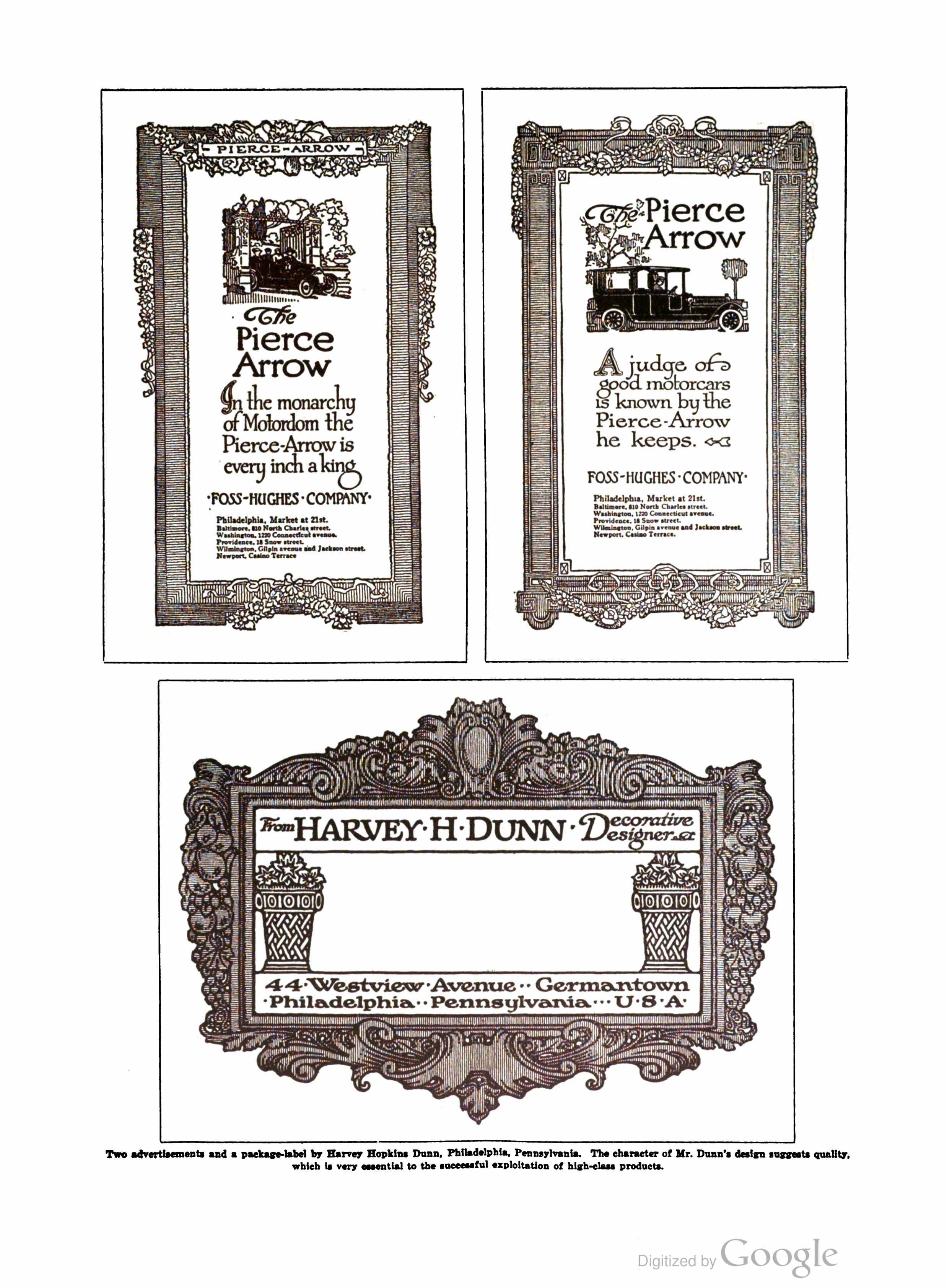
Dunn’s design was included in the feature about labels in The Printing Art, September 1915.


Samples of Dunn’s work appeared in The Inland Printer, January 1916. 


Dunn’s work was featured in the April 1917 issue of The Printing Art


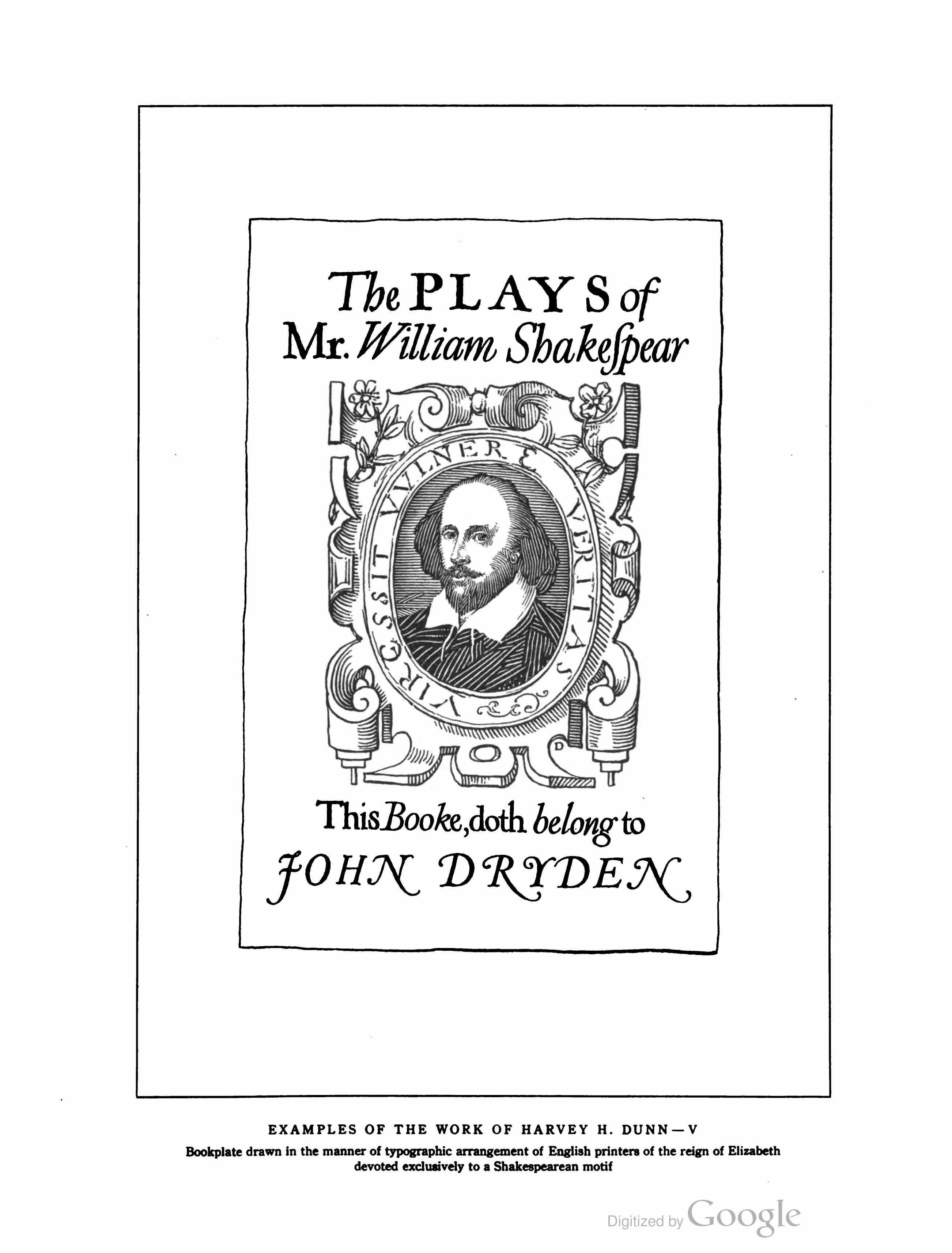
Below are samples of Dunn’s designs from 1917 and 1918. 

The Printing Art, October 1917

The Printing Art, November 1917

The Printing Art, January 1918

The American Printer, April 5, 1918

The American Printer, June 20, 1918

On September 12, 1918, Dunn signed his World War I draft card. He was a self-employed artist in Philadelphia. Dunn was described as medium build and height, with blue eyes and light brown hair. 


Dunn had the same address in the 1920 census. He was a self-employed artist and designer. 


Dunn was listed in the General Alumni Catalogue of the University of Pennsylvania for 1917 and 1922

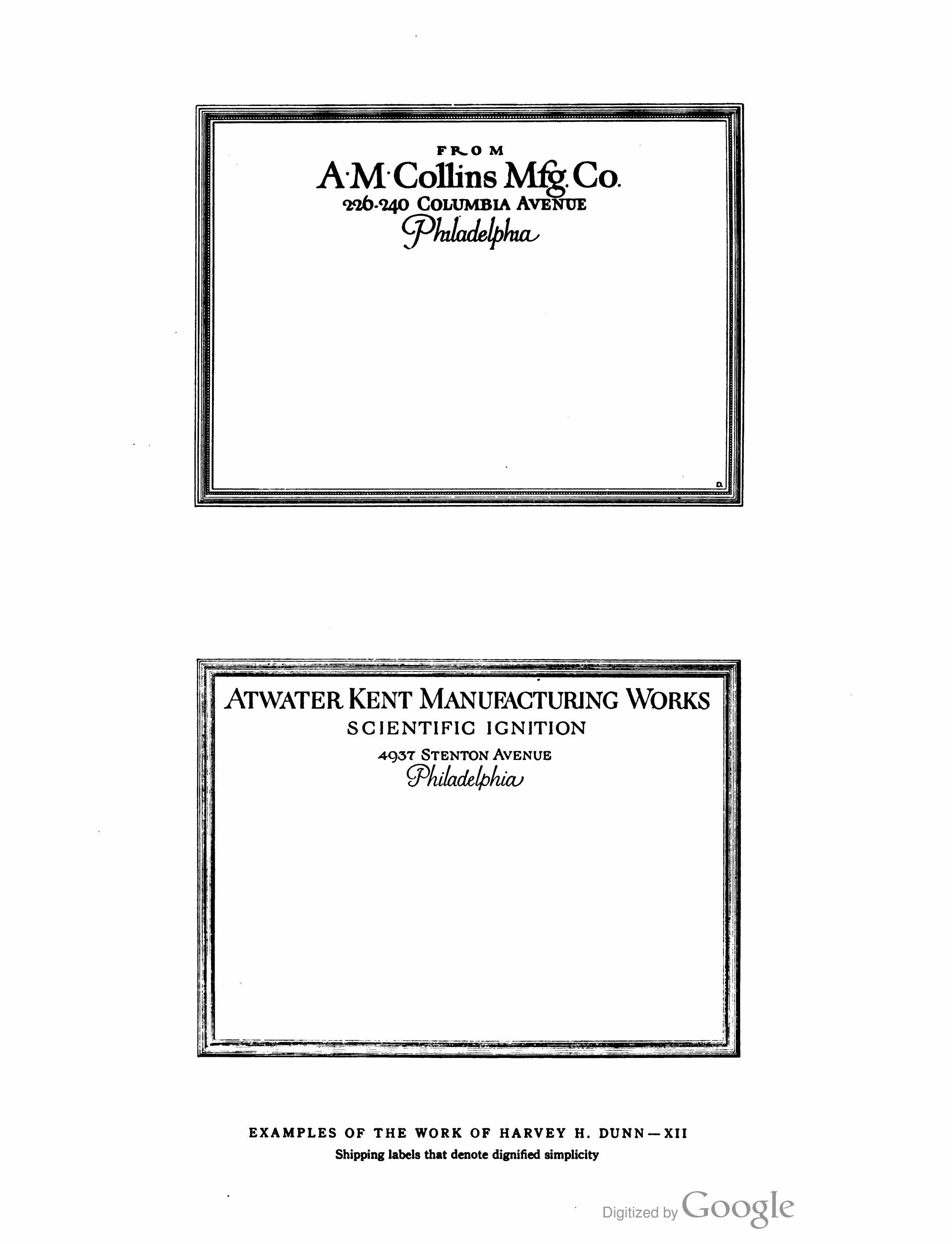
Below are samples of Dunn’s designs and a profile from 1919 to 1924. 

The Printing Art, July 1919

The Printing Art, October 1920

The Printing Art, November 1920

Annual of Advertising Art in the United States 1921

The American Printer, February 20, 1921

The Printing Art, February 1921

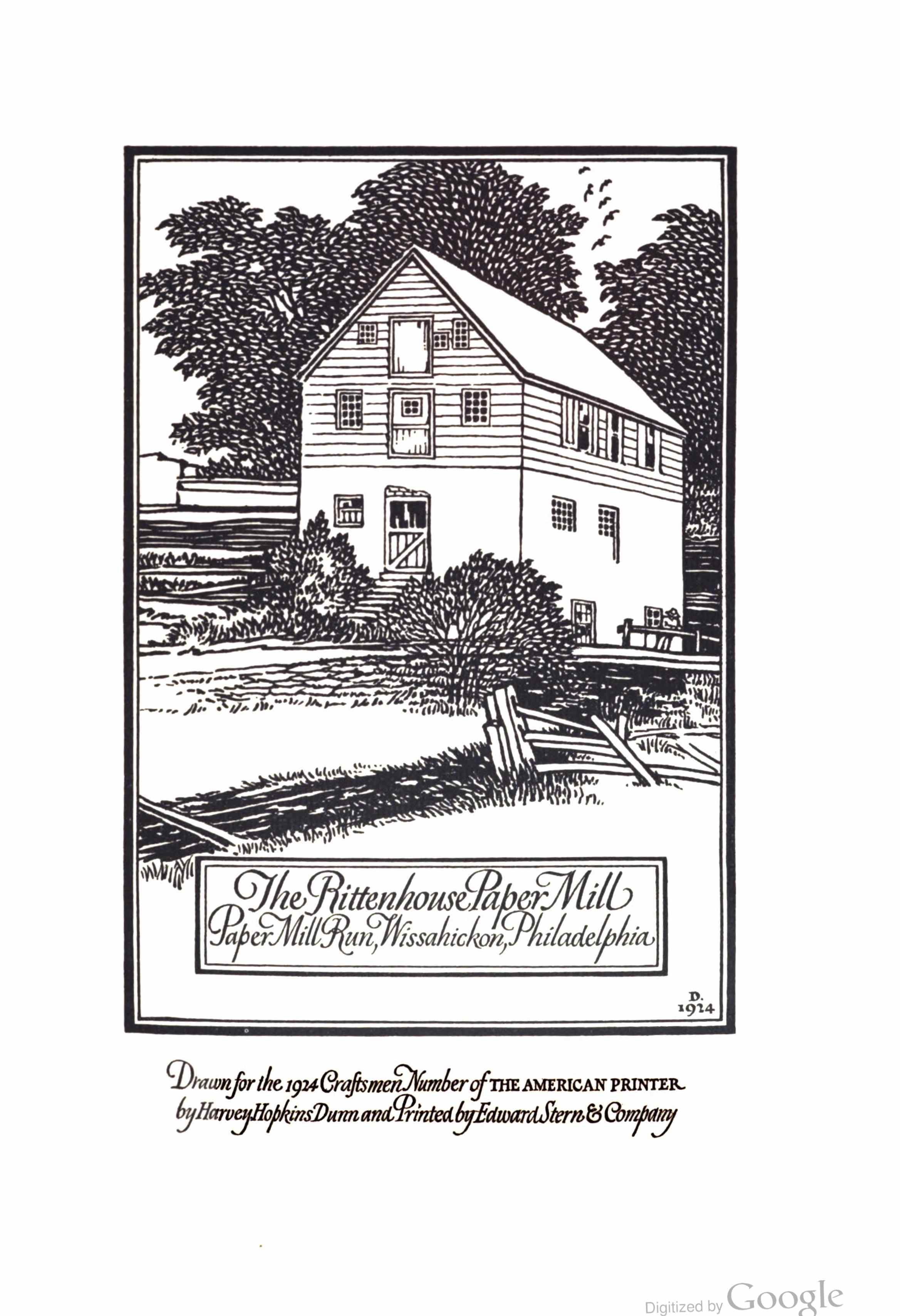
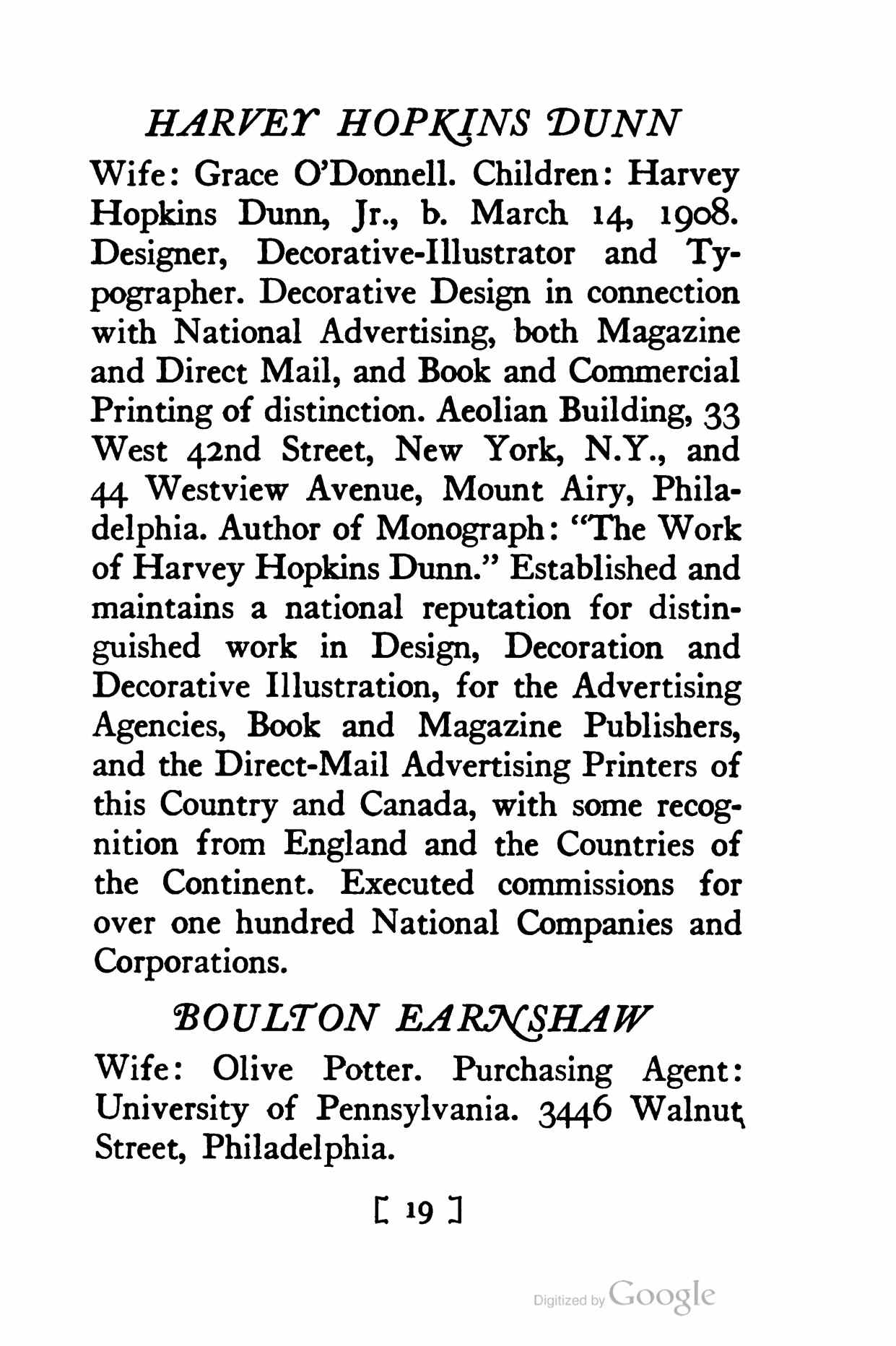
The American Printer, August 5, 1924

Dunn, Harvey Hopkins, 33 West 42nd, Lon 8536. Nat’l Adv. Ill., Allegorical, Borders, Decoration, Design, Figure, Heads, Historical Subjects, Landscapes, Layout, Lettering, Ornamentation, Poster, Portrait, Line Drawings, Pen and Ink, Wood Cut Rendering.


Dunn and his wife were counted in the 1930 census. They continued to reside at 44 Westview Street in Philadelphia. Dunn was self-employed as an artist and designer. His home was valued at $5,000. 


Dunn’s wife passed away in 1933. 

Sometime after 1935, Dunn moved to Burlington, New Jersey at 45 Wood Street, according to the 1940 census. 


On April 26, 1942, Dunn signed his World War II draft card. His home address was 312 Wood Street in Burlington. Apparently he had a studio at 1309 Locust Street in Philadelphia. 


Dunn passed away on May 10, 1947, in Burlington, New Jersey. A death notice appeared in the Philadelphia Inquirer, May 14, 1947. 
Dunn.—At Burlington, N.J., May 10, 1947. Harvey H. Dunn, formerly of Germantown, Pa. Funeral service art the Slack Funeral Home, Burlington, N.J., Tuesday, 2 P.M.


Further Reading and Viewing
Internet Archive, here and here
Luc Devroye, Harvey Hopkins Dunn


Related Posts