A Few Details About Dr. Mehemed Fehmy Agha
Dr. Mehemed Fehmy Agha was born on March 11, 1896, in Nicolaieff, Russia, (
Mykolaiv, Ukraine) according to his naturalization documents at Ancestry.com.
Who Was Who in America, Volume 7, 1977–1981 said Agha’s parents were Yossouf Agha and Anna Khoroz. Agha graduated, in 1913, from the Emperor Alexander Technical School; studied economics at Polytechnic Institute of Emperor Peter the Great in Petrograd, Russia to 1918; and studied political science at Ecole Nationale des Langues Orientales Vivantes, Paris, Dip., in 1923. Agha was studio chief of the Paris, France division of Condé Nast publications from 1924 to 1927. In Berlin, Germany, Agha was art director of
Vogue magazine from 1927 to 1929.
In 1928, Condé Nast traveled to Europe to find an art director for Vogue magazine in New York. In Berlin, Nast interviewed and hired Agha. Nast returned to New York on August 28 according to a passenger list at Ancestry.com.
On March 13, 1929, Agha and his wife, Claudine, were aboard the steamship Rochambeau when it departed Le Havre, France. They arrived in the port of New York on March 23. The couple planned to stay six months. (See lines 3 and 4)
Time, September 30, 1929, said “… a Russo-Turk named Mehemed Fehmy Agha whom Publisher Nast brought to the U. S. last month and made art director of all the Nast publications.”
On November 2, 1929, Agha and his wife boarded the
Delaware and Hudson Railway train in Montreal, Canada. They crossed into the United States at
Rouses Point, New York. Agha married Claudine Dementieff on December 11, 1928 in Berlin, Germany. She was born on November 13, 1892 in Tumen, Russia.
Agha and his wife began the naturalization process on January 30, 1930.
The 1930 United States Census was enumerated in April. Agha resided in Manhattan, New York City at 5 Prospect Place. His occupation was art professor.
The Inland Printer, April 1930, highlighted
Time magazine’s response to Agha’s elimination of capital letters in
Vanity Fair.
On February 4, 1936, Agha and his wife became naturalized citizens.
Agha appeared in
Life, September 6, 1937.
The New York Sun, January 19, 1940, said
An option granted to M. F. Agha to purchase 2,000 shares of common stock of Conde Nast Publications, Inc., at $5 per share, which expired by its terms on December 31, 1939, has been extended to December 31, 1941.
In the 1940 census (enumerated in July), Agha lived in Pound Ridge, Westchester County, New York at South Salem – High Ridge Road. In 1935, he lived in Darien, Connecticut. The art director earned $5,000 in 1939.
On April 25, 1942, Agha signed his World War II draft card. His address was 212 East 48th Street, New York City. Condé Nast Publications was his employer. Agha was described as five feet eight inches, 180 pounds, with brown eyes and black and gray hair.
Two of Agha’s co-workers were William Golden and Cipe Pineles who married in 1942.
The 1950 census said Agha lived at 140 West 57th Street near Carnegie Hall. He was a self-employed art director.
Agha’s wife, Claudine, passed away on April 15, 1951 in Manhattan.
Dr. M.F. Agha
—floating kidneys and sliced Bodoni—
One of the real pioneers of modern design in advertising and publishing, Dr. M. F. (for Mehemed Fehmy) Agha now to a consulting art director to a number of publications, advertising agencies and retail stores. Born in Russia of Turkish parents, he says he speaks “four languages well and three badly.” He has written many articles and delivered many lectures on photography, typography and the graphic arts. A past president of the Art Directors Club of New York, he was one of the founders of the National Society of Art Directors.
. . . The AIGA Institute Medal was presented to Mehemed Fehmy Agha. consulting AD and former president of AIGA, by Ilka Chase at AIGA’s 43rd annual meeting . . .
Miss Caroline Hunter of Trinity Pass, long a resident of Pound Ridge, has sold her home to Dr. M. F. Agha of New York. Ruggles Barnard was the broker in the sale.
At some point, Agha moved to
Malvern, Pennsylvania.
Who Was Who said Agha passed away on May 27, 1978, in Malvern.
Further Reading
Searching for William Golden and Finding William Goldberg
William Golden was born William Goldberg on March 31, 1911, in Manhattan, New York, New York. His birth surname was found at Ancestry.com birth and census records. Golden’s family was found in censuses through a list of survivors in his obituary at The New York Times, October 24, 1959.
Golden’s World War II draft card said he was born on March 31, 1911. The New York, New York Birth Index, at Ancestry.com, does not have a William Golden born on that date. There was a William Goldberg born on March 21, 1911.
A closer look at the low quality image showed 21 was actually 31. There was a transcription error in the database. William Goldberg was born on March 31, 1911.
The obituary named Golden’s surviving siblings: Abraham, Herman, Joseph, Murray, Max, Michael, and Clara. Those names closely match the Goldberg family in the 1910 United States Census. Murray and Herman were Morris and Hyman. In the 1961 book, The Visual Craft of William Golden, is a profile of Golden. He grew up in Manhattan’s Lower East Side and was the last of twelve children. According to Nine Pioneers in American Graphic Design (1989), Golden’s parents were “Aaron Golden” and “Tobia Entin Golden”. The 1910 census said the father was Harry, who would be Aaron in later census enumerations. Tobia’s name also changed. The Goldberg family resided at 328 East 8th Street. The census listed eight children. Golden was born the following year.
The Goldberg family has not yet been found in the 1915 New York state census.
According to the 1920 census, the Goldbergs were Bronx residents at 464 East 141st Street.
The 1925 New York state census recorded the Goldbergs in the Bronx at 966 East 181st Street. Visual Craft said Golden attended the Vocational School for Boys (138th Street and 5th Avenue) where he learned photo-engraving and basic graphic design. Sometime in the late 1920s he moved to Los Angeles, California.
In 1930, Golden/Goldberg resided at 716 North Irving Boulevard in Los Angeles. He was an artist working in photo-engraving.
Visual Craft said … A few years later he returned to New York where he became a member of the promotion department of the Journal-American.
The turning point of his career came when his talents were spotted by Dr. M. F. Agha, the noted Art Director of Conde Nast publications, who invited him to join House and Garden. After serving an apprenticeship under Dr. Agha who, in Golden’s own words “. . . forced the people who worked for him to try constantly to surpass themselves,” he left in 1937 to join the Columbia Broadcasting System. Three years later he was appointed Art Director of CBS.
Golden has not yet been found in the 1940 census. On October 16, 1940, Golden signed his World War II draft card. His address was 405 East 54th Street. Golden’s employer was the Columbia Broadcasting System. His description was five feet ten inches, 165 pounds, with blonde hair and blue eyes. His brother, Michael Golden, was next of kin.
On October 10, 1942, Golden and Cipe Pineles obtained, in Manhattan, marriage license number 20975. Visual Craft said they married the next day.
Visual Craft said
… In 1942 Golden took a leave of absence from CBS to work in the Office of War Information in Washington, D.C., and a year later entered the United States Army as a private. After serving as Art Director of Army training manuals in Washington and, later in Europe, with the Army’s Education and Information Division, he was discharged in 1946 with the rank of Captain. He resumed work at CBS, and in 1951 became Creative Director of Advertising and Sales Promotion for the CBS Television Network.
Golden passed away on October 23, 1959, in Stony Point, New York.
Further Reading
Advertising Requirements, June 1959, “Typographic Design Is Not Art!”
Art Direction, December 1959
Industrial Design, January 1963, Ralph Caplan review of The Visual Craft of William Golden
Rochester Institute of Technology
A Few Details About Will Burtin
Will Burtin was born Wilhelm Buertin on January 27, 1908, in Cologne, Germany, according to his Declaration of Intention naturalization application and World War II draft card. His Social Security application has the seventh as the birth day.
On July 6, 1938, Burtin and how wife, Hildegard, departed on the steamship Statendam from Rotterdam, Netherlands. They arrived at the port of New York on July 13.
Burtin started the naturalization process on November 25, 1938.
The Brooklyn Eagle (New York), September 24, 1939, reported Burtin’s appointment.
2 Instructors Added to Pratt Art School
Two additional appointments to the faculty of the Pratt Institute School of Fine and Applied Arts were announced yesterday by James C. Boudreau, director of the school.
... Will Burtin will become an advertising design instructor in day and evening sessions at the institute. Mr. Burtin designed the official souvenir book of the New York World’s Fair and was also the' designer of the WPA exhibit at the Fair.
The 1940 United States census recorded Burtin and his wife in Manhattan at 15 West 97th Street. He was a self-employed commercial artist.
On October 16, 1940, Burtin signed his World War II draft card. His address was the same. Burtin was an instructor at Pratt Institute in Brooklyn. He was described as six feet four inches, 206 pounds, with brown eyes and hair. Burtin’s veteran’s file, at Ancestry.com, said he enlisted in the Army on July 14 and August 4, 1943 and was discharged on October 6, 1945.
According to the 1950 census, Burtin, his wife and daughter, Carol, resided at 13 West 106th Street in Manhattan. He and his wife designed for dress businesses.
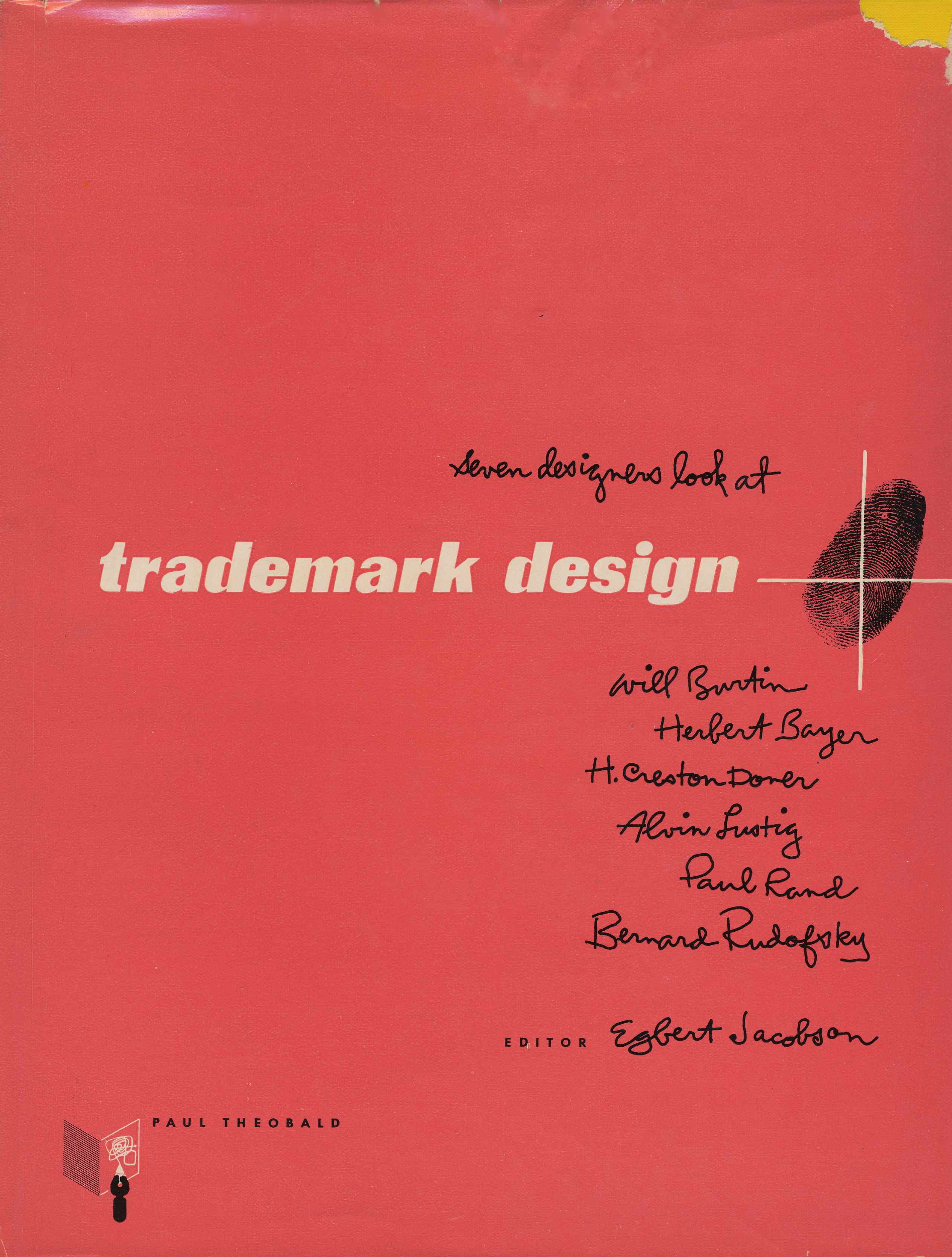
Will Burtin contributed “Trademarks/Tradenames” to the 1952 book, Seven Designers Look at Trademark Design.
In 1953, the Burtin family visited Rio de Janeiro, Brazil.
Art Direction, July 1957, designed by Will Burtin
The New York World-Telegram and Sun, April 10, 1959, reported Burtin’s return to Pratt Institute.
Pratt Institute Names Designer
Will Burton, designer consultant, has been appointed professor of Design at Pratt Institute, president Robert F. Oxnam has announced.
Dr. Oxnam also announced that Mr. Burtin would become head of the department of visual communications, formerly the department of advertising design, at the beginning of the next academic year. Mr. Burtin served on the Pratt faculty from 1939 to 1943.
The New York State, Marriage Index said Burtin and Cipe Golden were married on January 28, 1961 in Stony Point, New York.
Burtin passed away on January 18, 1972. He was laid to rest at Oak Hill Cemetery. Obituaries appeared in The New York Times, January 20, 1972 and Journal-News (Nyack, New York), January 24, 1972, below. Will Burtin, designer
Memorial services were held Saturday at the Church Center for the United Nations for Will Burtin, 64, the internationally noted designer who lived in Stony Point. He died Tuesday at Mt. Sinai Hospital after a brief illness.
Winner of the 1971 Gold Medal of the American Institute of Graphic Arts, he had recently been appointed research fellow in visual and environmental studies of the Carpenter Center for Visual Arts at Harvard University hut was unable to assume the post because of illness.
At his death he was designing an exhibit for the United Nations Conference on Human Environment to be held in Stockholm in June.
Burtin was one of the foremost exponents in this country of the principles developed during the twenties and thirties in Europe by architects and designers such as LeCorbusier in France, Mies van der Rohe in Holland and the Bauhaus group in Germany. His application of these principles to problems of mass communication brought him worldwide fame and attracted many students and disciples.
He received his early training in Germany and came to this country in 1938. One of his first commissions here was to design all the exhibition units of the Federal Pavilion at the 1939 New York World’s Fair.
Surviving are his wife, Cipe Pineles Golden; a daughter, Mrs. Robert Fripp of Toronto; a sister, Mrs. Rosa Landsbeck of Cologne, Germany, and two grandsons.
A Few Details About Cipe Pineles
Cipe Pineles was born on June 23, 1908, in Gliniany, Austria, according to her naturalization application.
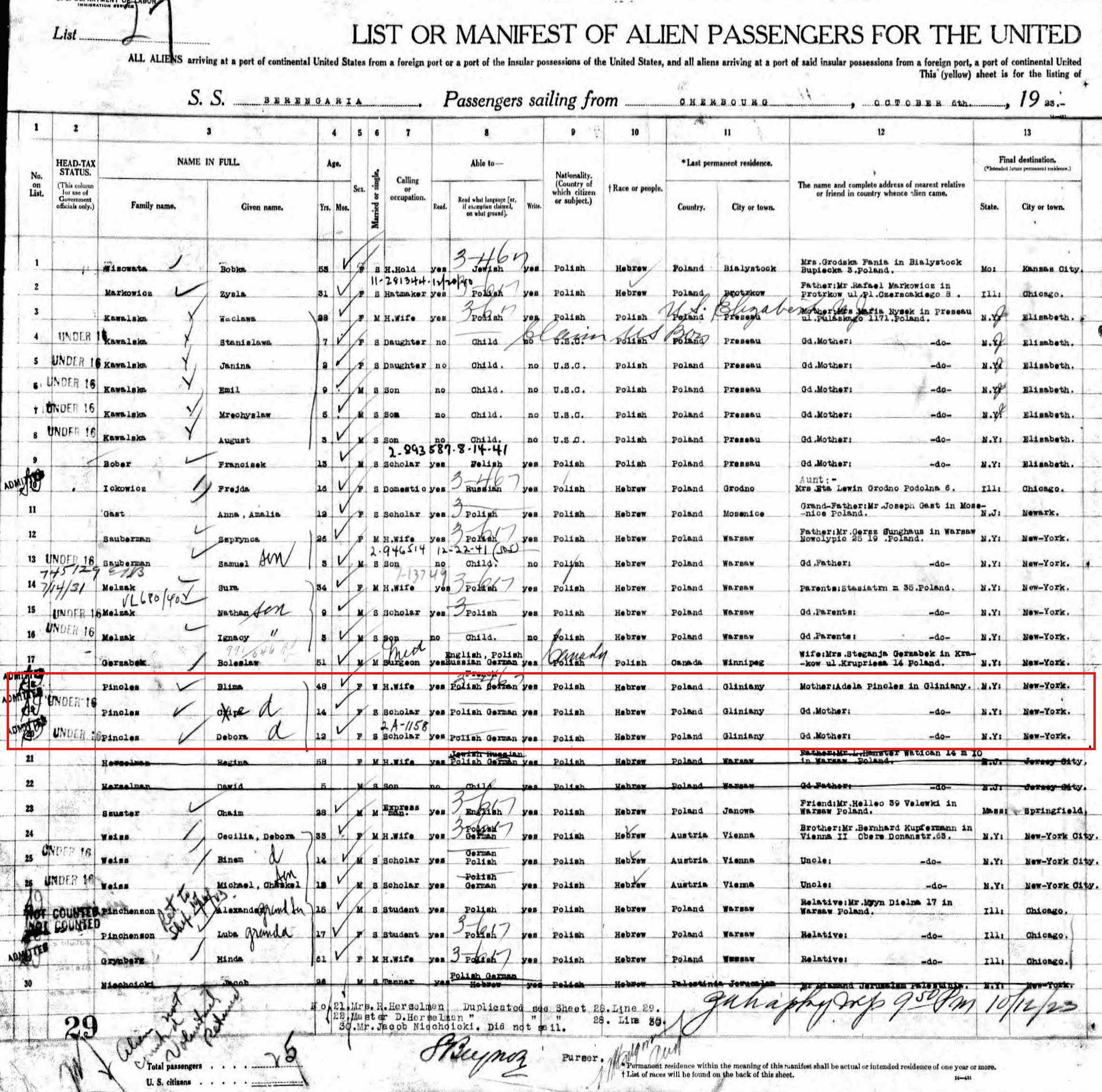
On October 6, 1923, Pineles, her mother and sister were aboard the steamship Berengaria when it departed Cherbourg, France. They arrived in the port of New York on October 12th.
The 1925 New York state census recorded Pineles as Celia, her mother and siblings in Bay Ridge, Brooklyn at 2367 65th Street.
Pineles graduated from Pratt Institute in 1929.
Pineles, Cipe
943 Carroll St., Brooklyn, N. Y.
Volley Ball, 1927; Class President, 1928.
The most remarkable water colorist in our
class. Boys, it’s too late; Cipe is wedded
to her art—and they’re both happy.
According to the 1930 census, the Pineles family numbered five in Brooklyn at 934 Carroll Street. Pineles was a freelance artist.
Pineles became a naturalized citizen on September 2, 1930.
Art from New York—Fair or No Fair
Pineles has not yet been found in the 1940 census.
The New York, New York Marriage License Index, at Ancestry.com, said, on October 10, 1942, Pineles and William Golden obtained, in Manhattan, marriage license number 20975. They married the following day.
Manhattan city directories for 1943 and 1946 listed Pineles at 405 East 54th Street.
Pineles and Golden have not yet been found in the 1950 census.
Pineles was featured in the magazine Print, September-October 1955.
Golden passed away on October 23, 1959.
On January 28, 1961, Pineles married Will Burtin in Stony Point, New York.
The Daily News (Tarrytown, New York), October 4, 1963, reported the selection of the Family Service symbol.
Burtin passed away on January 18, 1972.
Related Posts






.jpg)
