Richard Deane Taylor was born Meyer Tuckschneider on January 13, 1925, in Manhattan, New York City, according to the New York, New York Birth Index at Ancestry.com and his World War II draft card.
Taylor was interviewed by P.C. Hamerlinck in Alter Ego #2, Autumn 1999. Taylor said he “was born on the Lower East Side of Manhattan in 1925, the youngest of three brothers and sisters.” The 1925 New York state census recorded the Tuckschneider family at 234 Monroe Street in Manhattan. Taylor was the youngest of five siblings. Taylor’s parents and three older sibling were born in Poland and immigrated in 1922. His father was a tailor.


Detail, Lower East Side. In 1925, Taylor’s home was
a 15-minute walk to Jack Kirby at 131 Suffolk Street.
At some point the Tuckschneider family moved to Brooklyn. The 1930 U.S. Federal Census said they resided at 355 South 23rd Street.

According to the 1940 census, the family had moved to the Bronx at 797 161st Street.

In the interview Taylor said
I attended Brooklyn Technical High School, a 45-minute trip from my home in the Bronx. After the first two years of classes, studying mechanical and free-hand drawing among other technical subjects, my art teachers encouraged me to select the art program as my major for the remaining two years. Their arguments were all the more persuasive as they had rewarded me with numerous citations and a medal for my first two years of art.
Taylor was one of eighteen students who contributed initial letters and decorative design to the January 1942 yearbook, Blueprint. Taylor did not sign his work.
Taylor explained how he went to work for Fawcett Publications while still in school.
During my junior year in high school, a Dr. [Alexander] Aposdorf [sic], having seen some of my illustrated and lettered notebooks, suggested I get in touch with Frank Taggart [see sidebar] at Fawcett Publications and show him my work. Taggart was a former student of Dr. Aposdorf and a graduate of Brooklyn Technical High School where I attended. I called him a few days later and he invited me to come up and see him at Fawcett’s offices with samples of my work. He looked at my portfolio with great interest, but what caught his eye was my lettering. At Tech we were required to letter all our notebooks and, needless to say, after three years of lettering, I could letter faster than I could write.Taggart was so enthused with the quality of my work that he suggested we both go in and meet with Fawcett’s art director, Al Allard [see sidebar]. Upon reviewing my lettering samples, he asked if I would be interested in doing some speedball lettering for Fawcett He promptly handed me a set of eight penciled pages of a Whiz Comics Lance O’Casey story, along with a typewritten script. Since I was still a student at Tech, I did the lettering in the evenings and brought back the finished pages to his office the following week, after school. …
Taylor received more lettering assignments. Later he approached C. C. Beck about joining the Captain Marvel staff. Beck gave him an art test which he passed. Taylor inked the rope panels on three pages of “Captain Marvel and the Lie Detector” in Captain Marvel Adventures #23, April 1943.

On January 13, 1943, Taylor signed his world War II draft card. His Bronx address was 752 Trinity Avenue. Taylor’s description was five feet eight inches, 150 pounds, with black hair and brown eyes. This might be his serial number 32902307.

Taylor said he planned to continue his comic book career after the war. During the war he created posters, made training charts and illustrated manuals. This work affected his decision to pursue editorial and advertising commercial art
An obituary in The New York Times, November 25, 2014, said
He changed his name to Richard Deane Taylor in 1943, before he was drafted. In the U.S. Army, Richard received an American Service Medal, a Good Conduct Medal, and a Word War II Victory Medal. After his honorable discharge in 1946 as a sergeant, correctional custodial personnel/military police for the U.S. Disciplinary Barracks, Richard studied fine arts at the Academie de la Grande Chaumiere and the National School of Fine Arts/École nationale supérieure des Beaux-Arts in Paris, France.
Taylor has not yet been found in the 1950 census.
Five airline passenger lists, from 1951, 1952, 1953 and 1962, show Taylor departing Paris, France for New York. In 1953 he sailed from Paris to New York.
Taylor’s portrait of Chicago Tribune sports writer Arch Ward appeared in Collier’s, August 12, 1950. His artwork graced the cover of Collier’s, October 27, 1951.
Taylor was one of the illustrators chosen for the 1955 Imperial whiskey advertisements. Additional credits are at Who’s Who of American Comic Books 1928–1999.
The 1960 Manhattan, New York City directory listed Taylor at 42 East 50th Street.

On August 29, 1963, Taylor and Helena Roine obtained a marriage license (number 6164) in the Bronx.
Taylor produced maps for three books by Dan Kurzman. Depending on the map, Taylor lettered all or most of the text. Some map titles were typeset.
The Race for Rome (1975)
Rome 1943–44, detail below

Ben-Gurion: Prophet of Fire (1983)
Fatal Voyage: The Sinking of the USS Indianapolis (1990)
Endpaper, detail below

Taylor said he was an art teacher at the high school and university levels. For over twenty-five years, Taylor was the Acting Chairman of the Art Department of the High School of Art and Design. He retired in 1989 and pursued painting in oil and gouache, and work in other media.
Taylor passed away on November 21, 2014, in New York City. He was laid to rest at the Brigadier General William C. Doyle Memorial Cemetery.
Further Reading
Huffpost: The Last of the Real Mad Men
Related Posts
A. Machine and Royal Cartoon, Mario Acquaviva, Al Allard, Gerald Altman, Gene Barnett, Vivian Berg, Daniel Bhang, John Bulthuis, Ray Burley, Ray Burzon,
Jean Callahan, Helen Chu aka Duffy Mohler, Milton Cohen, Ellen Cole, Herb Cooper, Danny Crespi, Laurens Crossley,
Gerda Gattel, Selma Meyers Gleit, Louis L. Goldklang, Angelo Grasso, Anita Greene, Al Grenet, Ed Hamilton, Delores Heilman, Ray Holloway, IBM Directory, Alex Jay, Albert and Charlotte Jetter,
Abe Kanegson, George Kapitan, Anna Kaufman, Gary Keller, Rick Keller, Nadine French King, Ralph Komisarow, Grace Kremer, Morrie Kuramoto, Al Kurzrok,
Bob Lander, Bob Laughlin, Bob Leatherbarrow, Shelly Leferman, Len Leone, Joe Letterese, Veda Lufkin,
Robert N. MacLeod/Leroy Lettering, Lee Maroshek, Larry Mayer, Ed McLean, Jack Meltzer, Mel Millar, Jim Novak, Bill Oakley, Ben Oda,
Walter Palais, Stephen Palmisano, Charles Paris, Otto Pirkola, Fred Proctor, Jerry Robinson, Joe and Sam Rosen, George Roussos,
Georgette Sauterel, Ira Schnapp, Irving Settel, Rome Siemon, Artie Simek, Lora Sprang aka Pat Gordon, Herman Stackel, Stan Starkman, Daisy Swayze, Zoltan and Terry Szenics,
SIDEBAR: Frank Taggart
Frank Alfred Taggart was born on March 5, 1921, in Brooklyn, New York. His parents were Frank Martin Taggart and Clara L. Gardiner, who married in Brooklyn in 1919.
The 1925 New York state census recorded Taggart and his parents in his paternal grandmother’s household which included an uncle and two aunts. They resided in Brooklyn at 285 Webster Avenue. Taggart’s father was a chauffeur.
In the 1930 U.S. Federal Census, Taggart and his parents lived at 707 Coney Island Avenue in Brooklyn. They have not yet been found in the 1940 census.

1941 photograph detail of Taggart and 19
Fawcett artists in Alter Ego #96, August 2010
In Alter Ego #2, Autumn 1999, and The Alter Ego Collection Volume 1 (2006), Richard Deane Taylor explained how he met Taggart.
… During my junior year in high school, a Dr. [Alexander] Aposdorf [sic], having seen some of my illustrated and lettered notebooks, suggested I get in touch with Frank Taggart at Fawcett Publications and show him my work. Taggart was a former student of Dr. Aposdorf and a graduate of Brooklyn Technical High School where I attended. I called him a few days later and he invited me to come up and see him at Fawcett’s offices with samples of my work. He looked at my portfolio with great interest, but what caught his eye was my lettering. At Tech we were required to letter all our notebooks and, needless to say, after three years of lettering, I could letter faster than I could write.Taggart was so enthused with the quality of my work that he suggested we both go in and meet with Fawcett’s art director, Al Allard. Upon reviewing my lettering samples, he asked if I would be interested in doing some speedball lettering for Fawcett. …
Taggart signed his World War II draft card on February 15, 1942. His address was 209 Quincy Street in Brooklyn. Taggart was described as five feet four inches, 170 pounds, with blonde hair and blue eyes.

Taggart’s veteran’s file, at Ancestry.com, said he served in the Navy from August 31, 1942 to November 5, 1945. His draft card was updated, on November 7, 1945, with a new Brooklyn address, 1011 Bedford Avenue. The Brooklyn Eagle, May 16, 1953, said Taggart was a “submarine man”.
Who’s Who of American Comic Books 1928–1999 said Taggart was a member of the C.C. Beck and Pete Costanza studio around 1946.
Taggart was the art editor of Fawcett’s Mechanix Illustrated from July 1947 to April 1953.
The New York City Marriage Index said Taggart and Alberta Berry obtained a license on March 22, 1950 in Brooklyn. They have not been found in the 1950 census which was enumerated in April. Maybe they were on their honeymoon.
Taggart was named twice in the American Institute of Graphic Arts’ Magazine Show of 1951.
The April 1956 issue of Interiors showed Taggart’s reclining chair and ottoman.
The 1957 Manhattan, New York City directory listed Taggart at 19 West 44th Street. His occupation was artist.

The FictionMags Index lists a “Frank Taggart” and “Alfred Taggart” as cover artists who did typographic designs in 1959, 1960 and 1961.
Taggart was mentioned in a 1960 issue of Interior Design, “... furnishings include a baby crib with cane panels from Frank Alfred Taggart ...”
Taggart was the cover art director of Radio-TV Experimenter magazine from Fall 1963 (cover art by Charles Mazoujian) to June-July 1965.
Popular Mechanics, December 1966, published Taggart’s schematic illustrations.
Taggart’s instructional drawings were published in Popular Science, January 1970.
Samples of Taggart’s later work have not yet been found.
Taggart passed away on January 8, 2000. The Social Security Death Index said his last residence was Milford, New Jersey.
SIDEBAR: Al Allard
Albert Pierre “Al” Allard was born on May 24, 1904, in Minneapolis, Minnesota according to the Minnesota Births Index, at Ancestry.com, and his World War II draft card. His parents were Edward George Allard and Isabella Mary La Fore.
The 1905 Minnesota state census recorded Allard and and his parents in Minneapolis. His father was a railroad conductor.
In the 1910 U.S. Federal Census, Allard and his parents resided at 3311 Fifth Avenue in Minneapolis. Ten years later, the census said Allard, his parents and brother, Edward, made their home at 4427 Pillsbury Avenue in Minneapolis.

In 1923, Allard graduated from Central High School. He was the art editor of the 1923 yearbook, Centralian, and contributed several illustrations and decorative designs.


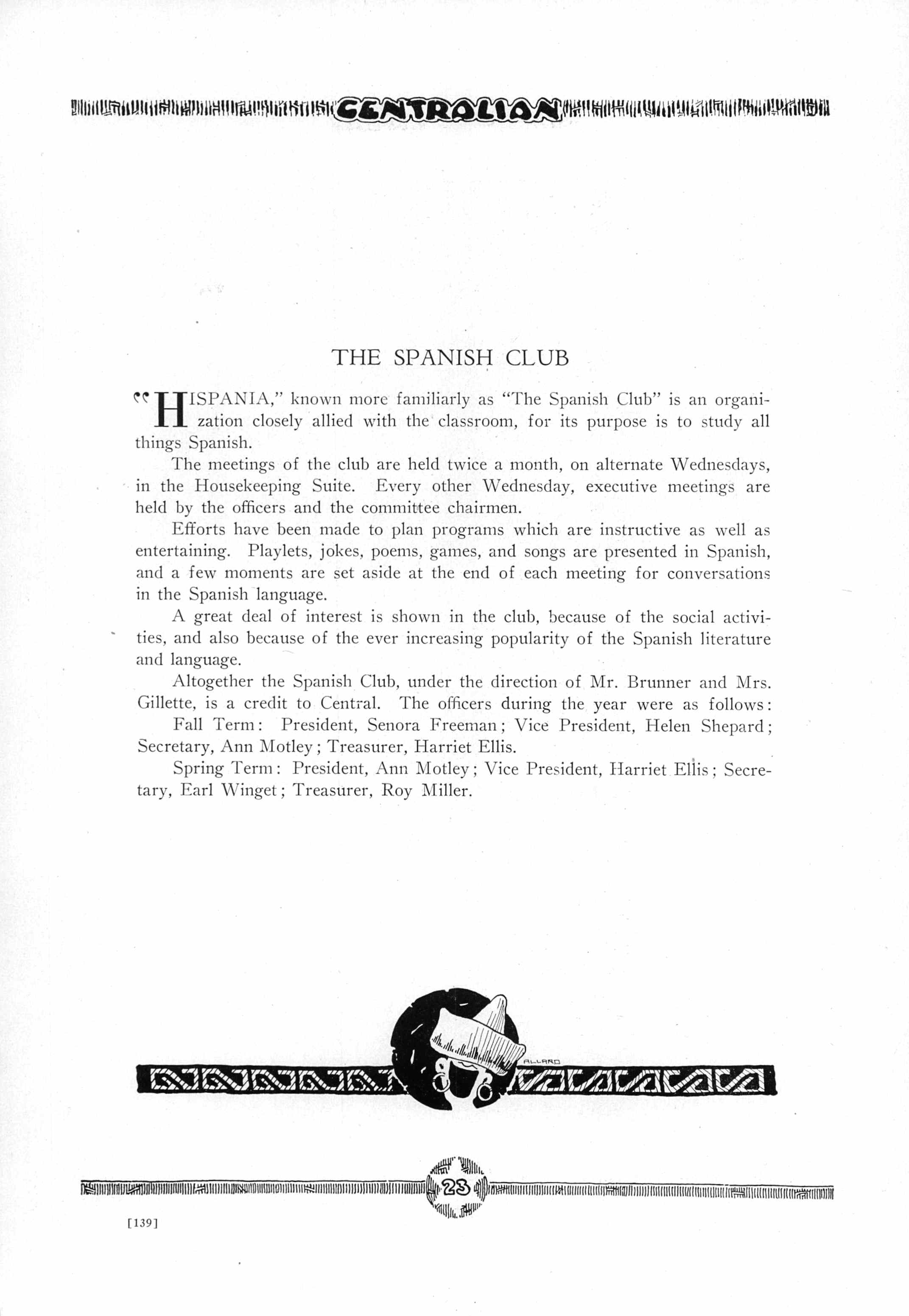


On May 1, 1926, Allard married Garnett A. Johnson. In the 1930 census, the couple were Minneapolis residents at 308 Fremont Avenue South. (The 1930 Minneapolis city directory listed apartment 304.) Allard was an artist working for a publisher. Allard’s employer was Fawcett Publications which moved its offices to New York City and Greenwich, Connecticut in the mid-1930s.
The Star-Tribune (Minneapolis, Minnesota), August 9, 1994, said
Allard … graduated from the old Central High School. In the late 1920s he worked in the theater district around Hennepin Av. in downtown Minneapolis. It consisted of 16 live-entertainment theaters. … While attending Central, Allard was a paint boy at a Minneapolis scenery studio. He worked in advertising and promotion at the Orpheum and State theaters for several years before he became art director for Fawcett Publications, started by William Fawcett in Robbinsdale.Allard and Vogel Albinson established Fawcett’s art department, which published the magazine “Captain Billy’s Whiz Bang.” It was small enough to fit into a shirt pocket. In 1934 Allard moved with Fawcett to New York …
According to the 1940 census, Allard, his wife and son were Greenwich residents at 17 Richmond Drive. In 1935 they lived in Pelham Manor, Westchester County, New York. Allard was an art director.
On February 16, 1942, Allard signed his World War II draft card. His address was 16 Richmond Drive, Greenwich, Connecticut. Fawcett Publications was his employer. Allard was described as five feet nine inches, 180 pounds, with black hair and brown eyes.

In Alter Ego #2, Autumn 1999, and The Alter Ego Collection Volume 1 (2006), Richard Deane Taylor explained how he met Allard.
… During my junior year in high school, a Dr. [Alexander] Aposdorf [sic], having seen some of my illustrated and lettered notebooks, suggested I get in touch with Frank Taggart at Fawcett Publications and show him my work. Taggart was a former student of Dr. Aposdorf and a graduate of Brooklyn Technical High School where I attended. I called him a few days later and he invited me to come up and see him at Fawcett’s offices with samples of my work. He looked at my portfolio with great interest, but what caught his eye was my lettering. At Tech we were required to letter all our notebooks and, needless to say, after three years of lettering, I could letter faster than I could write.Taggart was so enthused with the quality of my work that he suggested we both go in and meet with Fawcett’s art director, Al Allard. Upon reviewing my lettering samples, he asked if I would be interested in doing some speedball lettering for Fawcett. …
Allard was pictured in the Fawcett Publishing advertisement which ran in Advertising Age, September 14, 1942.

The 1950 census said art director Allard and his family lived on Hendric Lane in Greenwich.
Allard was mentioned in Art Director & Studio News, November 1953.
Minneapolis starts with exhibitThe AD Club opened the season with an exhibit of layouts and finished art for True Magazine. Al Allard, AD of True furnished the art work shown.Besides plans for future meetings, a committee was formed to entertain and paint murals in children’s hospitals.
Art Direction, March 1957, profiled Allard.

Allard’s art direction covered Fawcett’s numerous magazines including Modern Mechanix (retitled Mechanix Illustrated, June 1938), Battle Stories, Cavalier, Daring Detective, Dynamic Detective, Hollywood, Motion Picture, Movie Story, Rudder, Screen Secrets, Secrets, Triple-X Western, True, and Woman’s Day, and the mass market paperback line Gold Medal Books.
After 36 years at Fawcett, Allard returned to Minnesota where he retired in 1970.
Allard passed away on August 4, 1994, in St. Louis Park, Minnesota. He was laid to rest at Lakewood Cemetery.
(Next post on Monday: Charles W. Ransom, Master Penman)


