Walter Huxley was born on December 1, 1890, in New York, New York, according to his World War II draft card. His father’s name, Christian, was on Huxley’s 1940 marriage certificate. The 1940 U.S. Federal Census recorded his mother’s name, Anna, and birthplace, France. All of them have not yet been found in the federal and New York state censuses from 1900 to 1930.
By the early 1920s, Huxley was in San Francisco, California. In the American Printer, October 1926, Huxley described his training.
My readers would probably like to know something about the artist who designed the June 20 and August American Printer covers. He is Walter Huxley. His father wanted him to learn a trade, so young Huxley chose printing. After he learned the mechanics of the craft trade journals and books opened a new vista. Examples of fine printing by the early craftsman, with the decorations and wood cut illustrations, enthused him. Wishing to learn what other printers were doing and thinking about Mr. Huxley left New York and moved westward, working in printshop by the way. Not until he reached San Francisco, he says, did he find the spirit of craftsmanship he was seeking. There he was an executive with the Metropolitan Press, I quote him:
“There wasn’t a more enthusiastic crowd anywhere than the San Francisco Bay Cities Club of Printing House Craftsman. It was here that I came into contact with such exponents of the art as John Henry Nash, Edwin Grabhorn and Haywood Hunt. After listening to Mr. Nash and others at the meetings of the club I decided to go to Chicago to acquire additional skill. I wanted to take a course in drawing, composition, design and wood-block cutting at the Art Institute of Chicago, so that I could design illustrations and decorations to harmonize with typography.
“I attended classes during a regular three year course and two special summer courses [1922 to 1925] while working on the night shift of Bertsch & Cooper. In the splendidly equipped Bertsch & Cooper office the craftsman spirit prevailed, the work turned out being of the highest standard.
“One year of my course at the Art institute of Chicago was spent in the Department of printing Arts, directed by Ernst F. Letterer. Mr. Detterer is doing a good deal to develop the craft spirit through his classes. A great many students of his department are going into the advertising field or the the designing of fine books. In order that his students may appreciate the relationship between decoration, illustration and typography he teaches them through simple projects the essentials of type-setting. Mr. Detterer also has on hand a collection of some of the finest products of modern private presses, as well as specimens of earlier printing and manuscripts for the inspiration of his students.
“Last September I returned to New York City to continue my studies, Allen Lewis of the Art Students League was my instructor. He is another man moved by the spirit of craftsmanship and who has a fine graphic feeling in the woodcuts and lettering he designs.
“One thing I’d like to experiment with is this: to try to achieve a harmony between the mood of a story and the mood of its illustrations, typography and color. So that when you pick up a book that is gay in feeling—that same gayness will be expressed in the choice of type, in the quality of its illustrations and decorations, and in its color.”
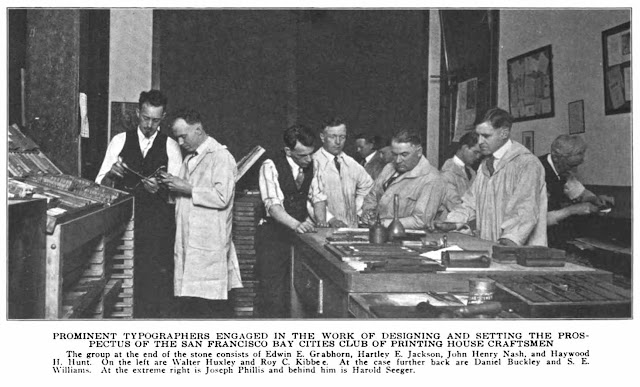
The Pacific Printer and Publisher, February 1922, wrote about the San Francisco Bay Cities Club of Printing House Craftsman. A photograph of the members included Huxley.
Far left: Huxley
This issue included an insert, “Craftsmanship in Printing: Its Development and Ideals and How it May Reach Its Highest Expression in San Francisco”.
The Inland Printer, April 1924, published a letter from Huxley who was a student at the Art Institute of Chicago.
As student of the department of printing arts of the Art School of the Art Institute of Chicago, I wish to express the gratitude of any fellow students and myself for the additional copies of the insert appearing in The Inland Printer for February, which you so kindly supplied us. We also appreciate the fact that through this publicity our school has been brought to the attention of the printing world. And as a printer, I should like to bring to the attention of craftsmen, and those who find pleasure and inspiration in fine printing, some facts about our department of printing arts, which I am sure will be of interest to them.
The department of printing arts is still in its infancy, having been organized in September 1921, with E. F. Detterer as director, for the purpose of training designers for the printing and allied trades. The course of study covers a period of two years, in addition to a year in the lower school required of every student. In the lower school, or first year, the student is taught the fundamentals of design, drawing, lettering and color. In the second year at the department of printing arts course of study includes book block design, cutting and printing, drawing from life with anatomy lectures, lectures and criticisms on pictorial compositions, lettering, typesetting, presswork, history of art and shop visits. The third year offers the student a choice of either the advertising design or book design work. The advertising design program includes drawing from life, printing design, typesetting and presswork, advertising design for posters, and magazine advertisements, and lettering. The book design course includes drawing from life, pictorial composition, lectures on composition, writing and illuminating, lettering, pen drawing, typesetting and presswork.
The mere outlining of the course gives but a faint notion of the ideals of craftsmanship which the student acquires. He becomes skilled, not only in designing attractive decorations, lettering and illustration, but he learns how to combine them with type, paper and ink, so that the whole project is a beautiful creation. Another source of inspiration and study to which the student has access is the collection of fine manuscript in the possession of the Art Institute, and some of Mr. Detterer’s collection, together with some originals and reproductions of the pages of the master printers and designers of the fifteenth and sixteenth centuries. From time to time the department receives specimens of craftsmanship from the Continent, giving us, for study, the modern point of view in the illustration and decoration of the printed page.
It was not until 1922 that the department acquired sufficient equipment, donated by printers and concerns of the allied trades, to do nearly all the work of typesetting and woodblock printing at the school. At present the type equipment is not nearly sufficient for the twenty-nine students. Here is a real opportunity for all craftsmen and those who struggle in the cause of better printing, to give practical help in building up an institution headed in the right direction. Just as soon as we get the type we need to set the beautiful pages, embellished with decoration and illustration, so much sooner can we hope to see them reproduced for your pleasure in Mr. Frazier’s Specimen Review department, or, if the privilege is again granted us, in another insert. Not only will you be helping us in our experimental work, but you will be helping to produce the draftsmen who, in the future, will be doing some of the best work in America, and you will aid in establishing a source from which skilled craftsmen can be drawn. Mr. Detterer, I am sure, will welcome the cooperation of craftsmen’s club and all individuals interested in the graphic arts.
The 1923 Chicago city directory listed a Walter Huxley at 1526 North LaSalle. He was a clerk at the Hyde Park YMCA.
In September 1925, Huxley moved to New York City. The New York Times, August 1, 1955, said Huxley worked at the American Type Founders Company. He was a member of the New York Typographical Union No. 6. Huxley and partners established the Huxley House in 1928. (The company’s address, 216 East 45th Street, was shared by Advertising Agencies Service Co. Inc., Continental Typefounders Association, Vandercook & Sons, Inc., and Photo-Lettering, Inc.)
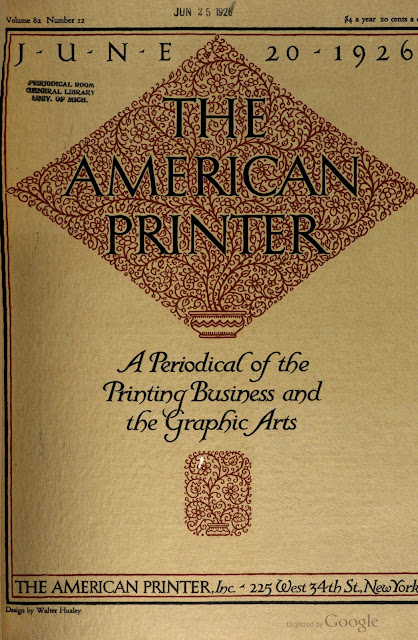
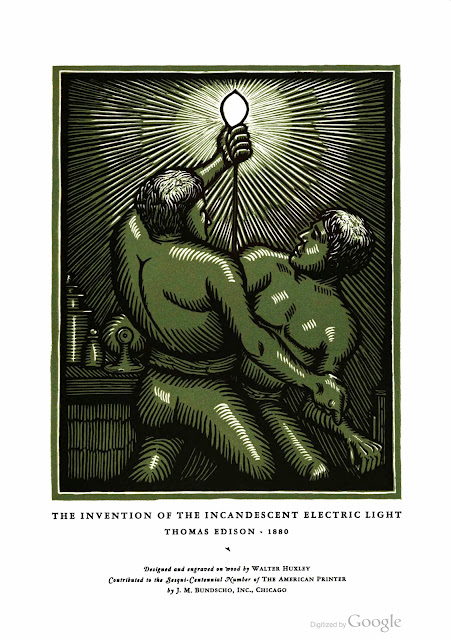
American Printer, June 20, 1926, cover design
American Printer, July 1926, illustration
American Printer, August 1926, cover design
The New York Post, May 5, 1930, reported the Art Directors Club prizes.
Decorative Designs
Walter Huxley, medal, for his drawing for the Bauer Type foundry.
Walter Huxley, first honorable mention, for his drawing for J. B. Moehm
Image found on eBay
The 1940 census recorded Huxley and his mother in Manhattan, New York City, at 235 East 50th Street. He was a self-employed typographer whose highest level of education was the fourth year of high school.
On June 19, 1940, Huxley and Ida Isabell Scott, a naturalized citizen born in Canada, obtained a marriage license in Manhattan. Ten days later they married on June 29. The witnesses were Hazel P. Scott and Herman Springer, according to the w York, New York, Index to Marriage Licenses at Ancestry.com. The newlyweds went on a cruise from June 29 to July 12.
On April 27, 1942, Huxley signed his World War II draft card. His address was 5101 39th Avenue, Long Island City in Queens. He was described as six feet two inches, 210 pounds, with hazel eyes and gray hair.
Huxley passed away on July 31, 1955, in Salisbury, Connecticut. An obituary appeared in the Star-Journal (Long Island City, New York) on August 1, 1955.
Funeral services for Walter Huxley, 64, of Woodside, a typographer and type designer, will be held at 1 P.M. tomorrow in Canaan, Conn.
Mr. Huxley, who lived at 51-01 39th avenue, died yesterday at his summer home in Falls Village, Conn.
He was one of the founders of Huxley House in Manhattan, a firm specializing in advertising typography.
Mr. Huxley studied four years at the Art Institute of Chicago and taught there for two years following his graduation.
He then returned to New York City, his birthplace, and took employment with the American Type Founders Company.
Mr. Huxley maintained his membership in the Typographical Union No. 6 after entering the Huxley House partnership in 1928. Six years later he designed “Huxley Vertical” type face.
He was chairman of the New York group of the Advertising Typographers Association of America Inc.
Surviving are his wife, Mrs. Ida Huxley, and two sisters.
Death of Walter Huxley Ends Long Career in Typography
Walter Huxley, who with Franz C. Hess founded Huxley House, advertising typography firm in New York City, died on July 31.
Born in New York 64 years ago, Mr. Huxley served his apprenticeship in composing rooms, then went to Chicago, where he studied under Ernest Detterer and worked with designer Oswald Cooper. He was associated with John Henry Nash in San Francisco for several years before he returned to New York. There he served in a number of plants and then joined the American Type Founders type design department. For many years Mr. Huxley represented the Advertising Typographers of America on the National Board on Printing Type Faces.
Further Reading
Related Posts








.jpg)


