Raymond Haskell Lufkin was born on January 29, 1897, in Salem, Massachusetts, according to his Massachusetts Birth Record (at Ancestry.com), his World War II draft card, Something About the Author, Volume 38, and Family Search. His parents were Joseph G. Lufkin and Amanda D. Low, both Massachusetts natives.
1900 U.S. Federal Census recorded the Lufkin family in Boston, Massachusetts at 112 Fowler Street. Lufkin had an older brother, Richard, and a younger sister, Annie. Their father was a traveling salesman.
Something About the Author said Lufkin was nine years old when his first published work, a prize-winning pen and ink drawing, appeared in the Boston Herald (probably in the children’s section called Boston Herald Junior).
The household gained two members in the 1910 census: Lufkin’s brother, Eben, and paternal grandmother, Sarah, a widow. They resided at 222 Harvard Street in Boston.
… At the present he is absorbed in an evening course in airplane design and mathematics, his interest in the subject carrying over from U.S. Army Air Corps courses in 1917–18 at Pratt Institute, Kelley Field and St. Paul. …
During his service Lufkin submitted cartoons and jokes to Judge which published several of them: September 28, 1918, October 5, 1918, October 19, 1918, November 16, 1918, November 30, 1918, and December 14, 1918.
In the 1920 census Lufkin and his siblings lived with their parents in Boston at 11 Grace Street. Lufkin was a designer in the advertising trade. Later that year, Lufkin married Adaline E. Lynch on December 16 in Minneapolis, Minnesota. The 1922 Minneapolis, Minnesota city directory listed Lufkin’s home address as apartment 18, 70 South 12th Street. The 1922 St. Paul, Minnesota city directory (below) said he was an artist at Brown & Bigelow, a publishing company. At some point Lufkin returned to Boston.
The 1924 Boston city directory listed Lufkin at 110 Warren Street in Brighton. He was an advertising artist and partner in Herrick & Lufkin, located at 80 Boylston Street, room 822, in Boston. He was also listed at the same address in the City of Boston Residents, April 1, 1924.
Advertising Arts & Crafts According to the 1926 Medford, Massachusetts city directory, commercial artist Lufkin was a resident at 12 Ash Street. In 1927 and 1928 his address was 17 Winter Street.
The 1930 census recorded Lufkin, his wife, a daughter and two sons in Wellesley, Massachusetts on Parker Road. His house was valued at nine thousand dollars. Lufkin was a self-employed advertising artist. Boston directories for 1930 and 1931 said Lufkin maintained his studio at 80 Boylston Street. The 1933 Wellesley directory (below) said his address was 16 Parker Road. In 1933 Lufkin moved again.
PM, Number 34, 1937 (below), featured the work of Lufkin and said “he studied with Vesper Lincoln George, Philip Hale, Vojecht Preissig, Bridgeman and Harvey Dunn.” In Boston he had worked with advertising agencies and printers such as BBDO and Barta Press. According to PM, in 1933 Lufkin went to New York City and was a free-lancer at Hal Marchbanks’ office where he designed, among other work, three calendars, from 1934 to 1936, for the Marchbanks Press. Lufkin and his family resided in Tarrytown, New York.
PM, number 36, 1938, featured Lufkin’s scratchboard portraits of Norman Munder, Will Bradley, Thomas Cleland, Frederic Goudy, and Bruce Rogers.
In the late 1930s Lufkin moved to New Jersey. The 1940 census said Lufkin lived in Tenafly, New Jersey at 124 West Clinton Avenue in Tenafly and was a Tarrytown, New York resident in 1935. The self-employed designer and illustrator owned his Tenafly house which was valued at $6,500.
On April 26, 1942, Lufkin signed his World War II draft card. He was described as five feet six inches, 152 pounds, with grown eyes and blonde hair. The card included his business address, 225 Varick Street, New York, New York, which was address of the printing firm, William E. Rudge�’s Sons. Sometime earlier Lufkin produced a moving announcement. He was not listed in the Manhattan directories from 1942 to 1944.
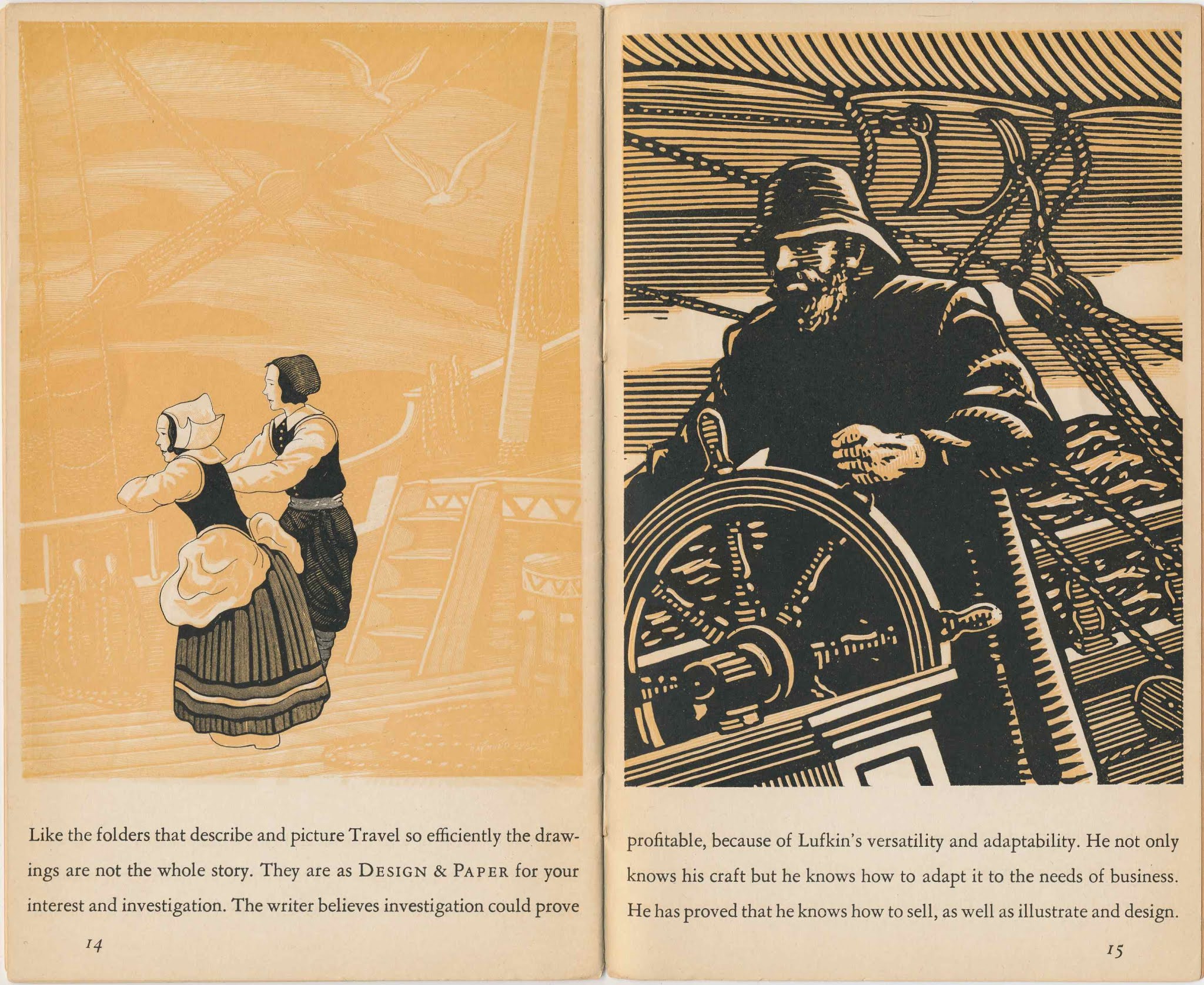
Design & Paper, Number 10, circa 1942, showcased some of Lufkin’s illustrations.
Something About the Author said Lufkin designed war bond posters for the Treasury Department and created military maps.
The Reader’s Digest, April 1944, cover featured Easter eggs decorated by 34 artists including Lufkin.
Manhattan city directories from 1945 to 1949 said Lufkin had an office at 130 West 42nd Street. The Manhattan directories in the 1950s and 1960s listed his Tenafly address and phone number.
Lufkin’s address in the 1950 census said “116”, instead of 124, West Clinton Avenue, Tenafly, New Jersey. He was a commercial artist working in commercial printing. The census said he worked 55 hours the previous week.
Lufkin advertised in Publishers’ Weekly.
October 14, 1947
November 1, 1947
December 6, 1947
Chicago Draugas, December 8, 1947
According to the 1950 census, Lufkin, his wife and son were Tenafly, New Jersey residents at 116 West Clinton Avenue. Lufkin was a commercial artist in the printing industry.
Lufkin retired to Florida where he passed away on December 10, 1978, in Saint Petersburg. An obituary was published in the Asbury Park Press (New Jersey), December 17, 1978. St. Petersburg, Fla.—Raymond Lufkin, 79, a former resident of Freehold, N.J., died here Dec. 10 at a local hospital. Mr. Lufkin was an artist who had designed and illustrated many books, advertising booklets and other published works. He had moved here nine months ago from Freehold, N.J. He was a member of the Society of Illustrators. Surviving are a son, Dudley D., here, and three grandchildren. The National Cremation Society was in charge of arrangements.
Books and Pamphlets with Illustrations by Lufkin
The Boroughmonger
R.H. Mottram
Dust Jacket
Little, Brown, and Company, 1929
Ood-le-uk Wanderer
Alice Alison Life and Margaret Johansen
Little 1930
Jimmy Goes to War
Leslie W Quirk
Little Brown and Co., 1931
Moccasin Trail: The Story of a Boy Who Took the Trail with Kit Carson
Reed Fulton
Doubleday, 1931
All Aces
Captain Samuel Taylor Moore
McLoughlin Brothers, Inc., 1932
Fighting Aces
Captain Samuel Taylor Moore
McLoughlin Brothers, Inc., 1932
Under Sea Heroes
Captain Samuel Taylor Moore
McLoughlin Brothers, Inc., 1932
The Snakeblood Ruby
Samuel Scoville, Jr.
Dodd, Mead, & Co., 1932
Big Flight
Francis and Katherine Drake
Dust Jacket
Little, Brown, and Company, 1934
In 1937, a book about the building at 40 Wall Street was published. It was described in
American Printer, May 1937.
Wall Street Buys a Book
You probably never will print a book like this. It measures 20 x 26 inches over all. It weighs 20 pounds. It’s bound in what at first sight appear to be quarterinch-thick sheets of plate glass. And it was printed in an edition of 12 copies. But whether you do or not, the fact that such a book WAS printed should be cause for rejoicing to you and to every other printer, for it shows that once again there is a market for fine printing—that an opportunity exists today such as you have not had since pre-depression times to sell the best you are capable of producing.
William E. Rudge’s Sons, New York, was the organization that printed the job—and not only printed it but designed it, planned it, wrote it, and, in cooperation with the client, developed a procedure for presenting it. Its purpose was to help Starrett Brothers and Eken, builders and managers of the Manhattan Co. building at 40 Wall Street, present the story of that building to corporation executives and directors and other major prospects for office space—present [text missing]
Obviously, something more than “just printing” was called for, and the giant size, unusual binding, restrained typography, brief text, and 17 large photographic illustrations, one of them in full color—they are actual photographic prints mounted in, not reproductions—were all planned and worked out with these very practical ends in view.
Plexiglas, an “unbreakable thermoplastic exactly resembling plate glass,” was used for the first time in the binding, which was done by Russell-Rutter Co. Text in Garamond. Printed in two colors on Strathmore Rhododendron Cover, white. Scratchboard drawings in text by Raymond Lufkin.
Black Land White Land: A Reggie Fortune Novel
H. C. Bailey
Dust Jacket
Doubleday, Doran, 1937
Medieval Days and Ways
Gertrude Hartman
Macmillan, 1937
Treasure Mountain
Eric Philbrook Kelly
Macmillan, 1937
The Inexhaustibility of the Subject of Christmas: A Holiday Dissertation
Leigh Hunt
William Bradford Press, 1937
A Merry Christmas Book of Christmas Facts and Fancies
Alfred C Hottes
Publishing Printing Co., 1938
The Book of Hugh and Nancy
Eric Milner-White and Eleanor Shipley Duckett
Macmillan Co., 1938
The Year Is a Round Thing
Helen Ebeltoft Davis
Musson, 1938
At the Sign of the Golden Compass
E.P. Kelly
Macmillan, 1938
William E. Rudge’s Sons, 1940
Magic Tunnel: A Story of Old New York
Caroline Dwight Emerson
McClelland, 1940
Shattuck Cadet
B. J. Chute
Macmillan, 1940
Yukon Holidays
Felice Fieldhouse
Longmans, Green and Co., 1940
Building an Empire
Louise Lamprey
Frederick A. Stokes, 1941
Fiduciary Trust Company of New York
William E. Rudge’s Sons, 1941
1941
Nobody's Vineyard
H. C. Bailey
Dust Jacket
Doubleday, Doran and Co., Inc., 1942
Man of Molokai: The Life of Father Damien
Ann Roos
Lippincott, 1943
Here Is Africa
Ellen and Attilio Gatti
Map
Charles Scribners, 1943
Here Is Alaska
Evelyn Stefansson
Charles Scribner’s Sons, 1943
Straight Up
Henry B. Lent
Macmillan, 1944
The Autobiography of Benjamin Franklin
Peter Pauper Press, 1945
Here Is India
Jean Kennedy
Map
Charles Scribner’s Sons, 1945
California Pageant
Robert G. Cleland
Knopf, 1946
Wild Waters
Lewis S. Miner
J. Messner, Inc., 1946
Hawaii’s Queen, Liliuokalani
Adrienne Stone
Messner, 1947
A Saga of Commerce
The Staff of C. Tennant, Sons & Co., of New York
1947
The Story of the Bible People
Muriel Streibert Curtis
Macmillan, 1947
Turkey, Old and New
Selma Ekrem
Map
Charles Scribner’s Sons, 1947
The Story of the Negro
Arna Bontemps
Knopf, 1948
An Adaptation of The Story of Our Lady’s Juggler
Thomas J. McCabe
Privately printed, 1951
Terra, An Allegory
Faber Birren
Philosophical Library, 1953
The Unconsidered
Faber Birren
Citadel Press, 1955
We Were There with the California Forty-Niners
Stephen Holt
Grosset & Dunlap, 1956
Emma Gelders Sterne
Alfred A. Knopf, 1957
Ships Come and Go
Marie Elizabeth Smith
Charles Scribner’s Sons, 1957
Through Golden Windows: Adventures Here and There
Jeanne Hale
E.M. Hale, 1958
Through Golden Windows: Stories of Early America
Nora Ernestine Reust and Jeanne Hale
E.M. Hale, 1958
The Picture History of America
Alexander Van Rensselaer
Doubleday, 1961
Tenafly, 1894–1969
Virginia T. Mosley
Tenafly 75th Jubilee Committee, 1969
Further Viewing
Related Posts