Monday, August 6, 2012

Under Cover: Tales of the Dark Knight


Mark Cotta Vaz proposed to DC Comics a book celebrating Batman’s fiftieth anniversary. This book was handled by Joe Orlando, who was DC Comics’ Editor for Special Projects. Ballantine Books was chosen to publish the book.

MONDAY, JUNE 27, 1988

10:00 AM meeting at Ballantine Books, 201 East 50th Street, with Risa Kessler, editor, Stephen McNabb, copy editor, Fred Dodnick, production manager, and Alex Klapwald, production assistant.

At the meeting I was given a copy Vaz’s proposal plus a number of Batman books and posters for reference. Risa Kessler wanted the cover to incorporate Batman into the city architecture/skyline as Frank Miller had done in one of his Dark Knight Returns illustrations. She also hoped to get Miller to do the cover for this book. A date was set for me to present cover concepts.


SUNDAY, JULY 24, 1988

I began working on cover concepts. I incorporated Batman into the skyline with a bat reflected in the river. The title was off to the side like the Dark Knight Returns book.


One of the reference books from DC was Batman: Son of the Demon which showed Batman atop a building. I thought of trying something similar to what Will Eisner had done on the splash pages of The Spirit in which the letters S-P-I-R-I-T are part of the scene. 


What I came up with wasn’t clever like The Spirit but more like the biblical movie posters for Ben-Hur and King of Kings; the titles were in perspective and built of stone with characters from the movie placed in and around the letters.


I always preferred the Chrysler Building over the Empire State Building. The title became part of the architecture. Like the Son of the Demon cover, I had Batman looking down at the street.


FRIDAY, AUGUST 5, 1988

11:45 AM meeting at Ballantine Books to present my cover concepts.

Risa liked the concept of Batman in the skyline but Stephen, Fred and Alex preferred Batman on the
Chrysler Building (my favorite, too). The concept of Batman on the Chrysler Building plus photos of the Chrysler Building, for reference, were sent to DC Comics.

A few weeks later, the finished illustration was delivered to Ballantine Books. Sigmond Pifko, the illustrator, did the airbrush art on 30 x 40 inch illustration board. I was given an 8-by-10-inch color transparency of the illustration so I could do the cover mechanical. Using a scanner drum to make color separations of the art was the norm in the publishing industry. The transparency I had could have been scanned but Fred decided to make a conventional camera separation from the original illustration. As you may know, a transparency has a slight blueish tint. The typeface for the subtitle and author’s name was supplied by Photo-Lettering who photographically manipulated the type to match the perspective of the title. The book was published shortly after the release of Tim Burton’s Batman movie.

Cover proof; originally, the book measured
9 by 12 inches / 22.9 by 30.5 centimeters.

The book measured 8.375 by 10.875 inches
/ 21.3 by 27.6 centimeters.

Although Frank Miller did not do the cover, I think Pifko, a Canadian, did a terrific job. Sometime after the book was published in 1989, I called him. He told me that he had my concept drawing and a pencil drawing from Orlando, who had refined my design and changed the attitude of Batman from looking down to turning and looking at you. A similar approach was used on The Amazing Spider-Man Annual 37, July 2010.


A “parody” of the cover was published as the cover of VAR Business, November 1991, which was included in the Print Regional Design Annual 1990. I mentioned it to Robbin Brosterman, a designer at at DC Comics, who informed Lillian Laserson, DC’s in-house counsel. A series letters between DC, VAR and CMP Publications resulted in a clarification.


(Next post on Monday: Herb Lubalin, part 1 of 7)

Monday, July 30, 2012

Typography: Asian American International Film Festival


Graphics for Asian CineVision’s 
20th Asian American International Film Festival

Concept sketch
Director’s chair drawn with a brush
Director’s chair as an optical illusion;
legs form the Roman numeral twenty.

I used Quark XPress to draw the director’s chair.
The font is Futura Medium. The program book
measures 9.5 by 12.5 in. / 24.1 by 31.75 cm.


(Next post on Monday: Tales of the Dark Knight)

Monday, July 23, 2012

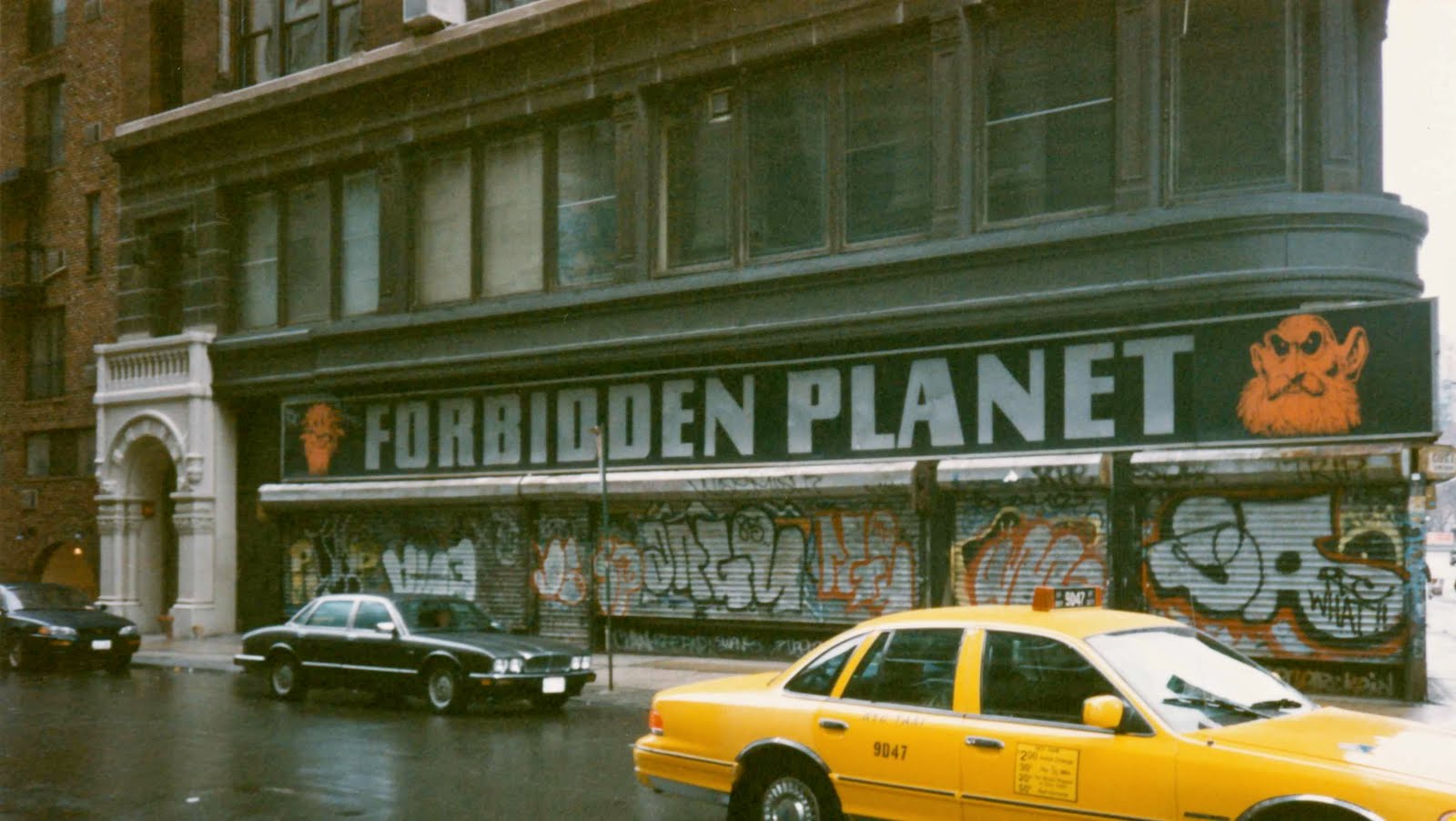
Street Scene: Forbidden Planet


• N E W Y O R K C I T Y •
821 Broadway at 12th Street, original Manhattan location

Broadway view
12th Street view

1996 relocation: 840 Broadway at 13th Street; logo by Alex Jay

Broadway view
Broadway view
13th Street view

Forbidden Planet moves to 832 Broadway on July 24, 2012.
 
 
Related Posts

Friday, July 20, 2012

Creator: Ira Schnapp

“…One day, I stopped the already ancient Ira Schnapp when he came up to the offices. He had been a letterer and logo designer beginning in the ’30s. He showed me how he took artist Joe Shuster’s crude Superman title and turned it into the trademark the world knows and recognizes today….”
—Michael Uslan, The Boy Who Loved Batman: A Memoir (2011)


Israel “Ira” Schnapp was born in Sassow, Austria on October 10, 1895, according to his World War II draft card. The 1910 United States Census recorded his family in Manhattan, New York City at 86 Ludlow Street. He was the fourth of seven children born to Max and Sadie. His father, a retail merchant in the grocery business, emigrated in 1895. His oldest brother, Jacob, followed in 1898. Schnapp, his mother and two older brothers, Samuel and Joseph, arrived in 1900. His sisters, Lena and Sarah, were born in New York.

Schnapp graduated from Stuyvesant High School in June 1913.

Schnapp signed his World War I draft card on June 5, 1917. His surname was misspelled as Schapp. Schnapp’s address in the Bronx was 483 East 170 Street. He was employed as a letterer at the W.T. Slide Company which was located at 115 East 23 Street in Manhattan. Schnapp was described as medium height and slender build with brown eyes and hair.

The New York, New York, Marriage Index, at Ancestry.com, said Schnapp married Beatrice Schwadron on September 30, 1918 in the Bronx.

In the 1920 census, which recorded Schnapp’s first name as Irving, he and Beatrice lived in the Bronx at 1510 Boston Road. He worked as an artist in the moving picture industry. The 1925 New York State Census found the Schnapps, with daughter Therese, in the Bronx at 2305 Grand Avenue. His occupation was artist.

The 1930 census said the Schnapps had a son, Martin, and remained in the Bronx but at 1455 Sheridan. Schnapp was a commercial artist. Sometime this decade he used the name Ira.

In 1936 Schnapp created a weekly panel, “The Art of the Ages”, which was syndicated by Curtis Newspaper Features, Inc., located at 45 West 45th Street in Manhattan. The syndicate’s partners were Julius H. Kamerman and William B. Curtis. “The Art of the Ages” was listed in Editor & Publisher on September 26, 1936; September 25, 1937; and September 24, 1938. In 1940 “The Art of the Ages” appeared in the Toledo Blade (Ohio), on page two of the Peach Section (near the end of the paper). The panel ran 24 consecutive weeks without a syndicate’s name.

 January 23, 1940

January 30, 1940

February 6, 1940
The Angelus byJean Francois Millet

February 13, 1940
Statue of Moses by Michelangelo

February 21, 1940
King Cophetua and the Beggar Maid by Sir Edward Burne-Jones

February 27, 1940
The Blue Boy by Thomas Gainsborough

March 5, 1940
Madame Le Brun and Daughter by Madame Le Brun

March 12, 1940
Aurora by Guido Reni

March 19, 1940
The Birth of Venus by Botticelli

March 26, 1940
The Night Watch by Rembrandt

April 2, 1940
The Statue of Perseus by Benvenuto Cellini

April 9, 1940

April 16, 1940
The Horse Fair by Rosa Bonheur

April 23, 1940
Hope by George Frederick Watts

April 30, 1940
Joan of Arc by Jules Bastien-Lepage

May 7, 1940
The Toilet of Venus by Francois Boucher

May 14, 1940
The Laughing Cavalier by Frans Hals

May 21, 1940
The Age of Innocence by Sir Joshua Reynolds

May 28, 1940
Mona Lisa by Leonardo da Vinci

June 4, 1940
The Potato Eaters by Vincent van Gogh

June 11, 1940
Bartolommeo Colleoni Statue by Andrea del Verrocchio

June 18, 1940

June 25, 1940

July 2, 1940
The Song of the Lark by Jules Adolphe Breton

The 1940 census listed “Ira Schapps” at 515 West 110 Street in Manhattan, his same residence in 1935. He remained a commercial artist, who had two years of high school education. 

Advertising Age, December 30, 1940, said
Join Superior Studios
Thomas G. Wiley has been named vice-president, and Jule Bauch, secretary and production manager, of Superior Studios, Inc., New York. Hector Zambrano and Ira Schnapp have joined the technical staff and Sam Golden and Merlin Lewis, the sales force.
In 1942, Schnapp signed his World War II draft card, which named George Iger as his nearest relative, a brother-in-law, who had married his sister, Lena/Lenore in the mid-1920s. In the 1930 census, Iger owned a restaurant, and in 1940 he operated a food packing business, Regis Food Company, according to his draft card. Schnapp’s mother lived with the Iger household in 1940.

Schnapp found work and employment in the comic book industry, and the rest is history, covered in-depth at Dial B for Blog’s “The Visionary: Ira Schnapp”, a ten-part look at his career; part 1 is here. Letterer Todd Klein spoke to artist Neal Adams, at the 2012 San Diego Comic-Con, about Schnapp and posted the information on Todd’s Blog.

According to the Social Security Death Index, Schnapp passed away July 1969 and his last residence was New York City. Schnapp’s birth date was given as October 10, 1892, three years earlier than the date on his World War II draft card. A death notice appeared in The New York Times, July 26, 1969.
Schnapp—Ira, beloved husband of Beatrice, devoted father of Martin and Teddy, loving grandfather of Jonathan David and dear brother. Services Sunday, 10:30 A.M. at “The Riverside,” 76 St. and Amsterdam Ave.
Census and military records at Ancestry.com were used in this profile. “The Art of the Ages” was found at the Google News Archive; I searched “Ira Schnapp" and got three hits, then I searched individual issues of the Toledo Blade. Schnapp’s panel appeared on Tuesday with one exception, when it was bumped to Wednesday. Like Schnapp, Artie Simek and Fred Eng were known mainly as letterers but they were also artists.

Todd Klein acquired printed copies of four “The Art of the Ages” and commented on them at his site.


Related Posts


Further Reading
Todd’s Blog, Ira Schnapp: His Life, Work and Family, Part 1, Part 2, Part 3, Part 4, Part 5 and Part 6
Who’s Who of American Comic Books 1928–1999
Wikipedia
Will Eisner Comic Awards Hall of Fame for 2025 Inductee
Ira Schnapp (1894–1969)
Schnapp was a logo designer and letterer who brought his classic and art deco design styles to DC Comics (then National Comics) beginning with the redesign of the Superman logo in 1940. He did a great deal of logo and lettering work for the company in the 1940s. Around 1949, he joined the staff as their in-house logo, cover lettering, and house-ad designer and letterer, and continued in that role until about 1967. He also designed the Comics Code seal.

(Updated October 2, 2025; next Monday: photos of the Forbidden Planet stores)