William Douglas “Bill” Oakley was born on April 1, 1964, in Oneonta, New York, according to his transcribed Social Security application at Ancestry.com. Also, his birth was noted in the Oneonta Star (New York), April 2, 1964.
Fox HospitalBirths—Mr. and Mrs. Theodore C. Oakley, Oneonta RD 2, Southside, son, 8 lbs. 1 1/2 oz., 5:34 p.m. April 1.
Oakley’s parents were Theodore Calvin Oakley (February 20, 1931–September 11, 1991) and Constance A. Simmons (May 24, 1939–January 22, 2020). Their marriage was reported in the Star, October 12, 1959.
Mr. and Mrs. Glen Simmons, 19 Fonda Avenue, have announced the marriage of their daughter, Constance, to Theodore Oakly [sic], also of Oneonta. Both are employees of Deckers Bakery. After a Washington D. C. wedding trip the couple will reside at 406 Main Street.
Oakley attended public schools. A hint of his talent was reported in the Star, October 21, 1971.
Youths win fire prevention awardsEighteen Oneonta youngsters became a little richer and a lot happier last week as they were named winners in the Oneonta Firemen’s “fire prevention” school contest. ...Three children from each elementary school were selected winners. According to contest chairman Donald Payne, the some 2,000 entries included posters, pictures and compositions.The entry judged best effort in each elementary school received a $12 cash award. Second best in the category K–4 or grade 5–6 received $8. Third place at the school was worth $5.Schools participating, the winners, their grade and place are:... Valleyview—...William Oakley, 2nd, third.
In 1982 Oakley graduated from Oneonta Senior High School. (His mother was in the class of 1957.)

1982 OHSan Yearbook
Some time after graduating, Oakley enrolled at the Joe Kubert School of Cartoon and Graphic Art.

In Comics Interview #54, 1988, Oakley was interviewed by Dwight Jon Zimmerman and said
... As far as a career, this has actually been the only thing I’ve ever considered, seriously, to do. I pretty much always wanted to draw comics. I went to the Joe Kubert school for a year, and the amount of homework that we got just kind of soured my taste for comics in a way. I didn’t feel I could really handle the amount of work that a comic artist has. I didn’t feel I could handle the workload, so I thought, you know, what else could I do that’s still in the comics industry? Lettering, I thought, was a good choice, good as any. It got me here, anyway.… I sent in some lettering samples to Marvel a little over a year ago and apparently they came right about at a time where Ron Zalme needed to hire a new staff letterer, because Danny Crespi was sick at that time, and according to him they came right in the nick of time. He called me up, asked me if I’d like to come out for an interview, which I did, and within a week he let me know that I had the job. So I packed all my stuff and moved down here.
The Telegraph (New Hampshire), June 9, 1991, published a profile of Oakley and said
After high school, Oakley attended art school in New Jersey for two years but said the experience disappointed him. When the 1986 term ended, he sent some samples to Marvel knowing he didn’t want to go back to school.Luckily for Oakley, just as he was growing disillusioned with art school, Marvel contacted him and praised the samples he had submitted. Since a job had just become available, Marvel brought Oakley in for an interview and hired him for the production staff.Oakley started out doing letter corrections for Marvel and also accepted any freelance lettering or inking work he could get to supplant his income.
In Comics Interview, Dwight asked “Is there any particular style that you try to follow or emulate?”
Bill: I would have to say John Costanza, more than anybody else. I like to think that my lettering style is unique but, you know, obviously, with so few letterers, you end up comparing somebody to somebody else. I’d have to say, if it would be anybody, it would be John Costanza. I’d like to think I letter like him.
Oakley said he designed the Mephisto logo and did the finished art for the Kickers Inc. logo which was designed by Bill Vallely. For lettering, Oakley said he uses a Hunt #107 Crowquill pen point and files it down. He said letterers Rick Parker and Phil Felix helped him a lot. Many of Oakley’s credits are at the Grand Comics Database.


Rejected Justice logo design
Dwight asked about splash pages.
Bill: They’re fun! I do like doing them. I like designing. You get to design the title, you know, for that issue. It’s fun. It’s kind of a challenge. You get to pretty much do what you want there, strut you stuff.

The Avengers #285, November 1987

The Avengers #292, June 1988
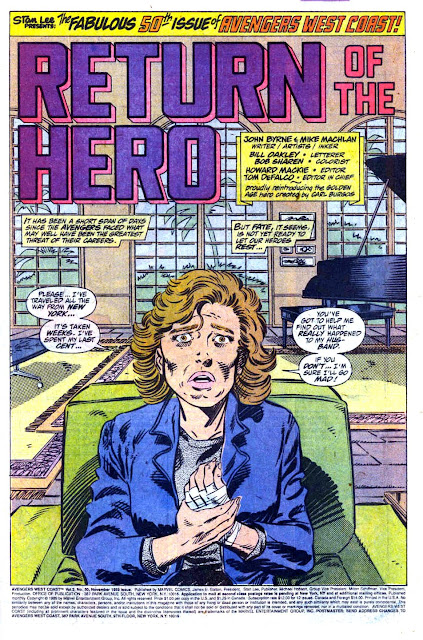
Avengers West Coast #50, November 1989


Avengers West Coast #70, June 1991

Daredevil #303, April 1992

The Amazing Spider-Man #395, November 1994

Amazing Spider-Man Super Special #1, 1995

Batman: Shadow of the Bat #76, July 1998

Spectre #3, May 2001
Dwight asked about the ideal balloon shape.
Bill: (Laughter.) I don’t know. I think Jim Novak gives the best balloon shapes, as far as that goes. I prefer to do them freehand only, because it’s easier for me. It’s easier and quicker, and I can make then look fairly clean. I really like the look of Jim Novak’s work. I like the fact that his balloons are so clean. He uses templates for that. I find freehand works best fo me.
Dwight’s last question was “What do you hope to be doing this time next year?”
Bill: I would hope, by this time next year, that I would have enough work that I could go free-lance. I wouldn’t mind the idea of working at home. That kind of appeals to me, not having to get up at 6:00 every morning to commute here. That I definitely would look forward to.
The Telegraph article mentioned Oakley’s return home.
Oakley, who moved back to Oneonta three years ago, is a freelance letterer for both major comic book companies—Marvel and D.C. As a fringe benefit, Oakley receives all the titles from the two companies.Of course, Oakley keeps himself so busy with his work that he doesn’t have any free time to read all those free comics books.”If that’s the price of success, I’ll pay it,” Oakley said.And Oakley is successful. He estimates there are about 100 letterers in the field and Oakley works on some of the most visible titles, including The Fantastic Four and two Superman comic books. …… Oakley said he earns about $20 per page and he is able to letter eight to 10 pages a day. He said he works eight to 10 hours a day, six days a week.“There are several things about him which make him a top letterer,” said Ralph Macchio, one of his editors at Marvel. “Certainly, the most important, is his lettering style, which is pleasing to the eye. Lettering itself is really an art.“Another thing about Bill is that he’s very fast which makes him very valuable since our deadlines are always crushing snd they never end. We’ll frequently send Bill eight to 10 pages at a time and say we need it overnight and Bill will do it.” …… After three years on staff, Oakley said he had gotten enough experience lettering to give freelance work a shot.He also realized he could do more pages each day if he was away from the New York City area where there were so many distractions.“I decided to come back here to save money because the cost of living is so much cheaper,” Oakley said. “Freelancing, you can pretty much live wherever Federal Express delivers.”
Draw #10, Spring 2005, published excerpts from Todd Klein’s online chat room for letterers from 1995 to 2000.
Todd Klein: What pen point do you prefer, Chris?Chris Eliopoulos: I use a Hunt 107, filed down. So do Mike Heisler, Bill Oakley, Ken Lopez, Jim Novak, Phil Felix ... and countless others. We call ourselves the “Magnificent 107s.”Todd Klein: One letterer I think is under appreciated now is Bill Oakley.Richard Starkings: Bill is, I think, the best of the more recent Marvel Bullpen bunch. When Bill improves his fonts and builds up his title font library, I’ll be watching my back.
Oakley passed away on February 16, 2004, in Utica, New York. The Star published an obituary on February 19.
Oneonta—William Douglas Oakley, 39, died Monday, Feb. 16, 2004, at St. Elizabeth's Hospital in Utica.
He resided on Main Street with his parents and wife for the last year and half.
He was born April 1, 1964, in Oneonta, the son of Theodore C. Oakley and Constance A. Simmons.
Bill attended Joe Kubert School of Cartooning and Graphic Art in New Jersey. He then went to work for Marvel Comics and other companies, and more recently was employed as a letterer for DC Comics in New York.
He was an avid fan of Pop Culture and enjoyed attending concerts, collecting comic books, but above all he loved his lettering career.
Bill is survived by his wife, Leslie (MacPherson) Oakley, whom he married on April 24, 2002; a son, Stephen Oakley; his mother and stepfather, Connie and Norman Quackenbush; four brothers, Curtis, Stephen and Danny Quackenbush and Tim Oakley; three sisters, Sherry (Quackenbush) Utter, Norma (Quackenbush) Clark and Theresa [sic] Oakley; several nieces, nephews, aunts, uncles and cousins; including a very special aunt and uncle, Ronnie and Jackie Simmons; and his stepmother, Carol (Oakley) Stafford. [Some of the survivors are on facebook.]
He was predeceased by his father, Theodore Oakley.
Calling hours will be held on Saturday, Feb. 21, 2004, from 3 to 5 p.m. at the Lewis, Hurley & Pietrobono Funeral Home, 51 Dietz St., Oneonta.
At the request of Bill, in lieu of flowers, contributions may be made to the Catskill Area Hospice & Palliative Care, Inc., 542 Main St., Oneonta, NY 13820.
Oakley was laid to rest at Maryland Cemetery.
Further Reading
Wikipedia
(Next post on Monday: Monocle)
Pulse News: Comiccon.com Panels Message Boards
Who’s Who of American Comic Books 1928–1999Wikipedia
Related Posts
A. Machine and Royal Cartoon, Mario Acquaviva, Al Allard, Gerald Altman, Gene Barnett, Vivian Berg, Daniel Bhang, John Bulthuis, Ray Burley, Ray Burzon,
Jean Callahan, Helen Chu aka Duffy Mohler, Milton Cohen, Ellen Cole, Herb Cooper, Danny Crespi, Laurens Crossley,
Gerda Gattel, Selma Meyers Gleit, Louis L. Goldklang, Angelo Grasso, Anita Greene, Al Grenet, Ed Hamilton, Delores Heilman, Ray Holloway, IBM Directory, Alex Jay, Albert and Charlotte Jetter,
Abe Kanegson, George Kapitan, Anna Kaufman, Gary Keller, Rick Keller, Nadine French King, Ralph Komisarow, Grace Kremer, Morrie Kuramoto, Al Kurzrok,
Bob Lander, Bob Laughlin, Bob Leatherbarrow, Shelly Leferman, Len Leone, Joe Letterese, Veda Lufkin,
Robert N. MacLeod/Leroy Lettering, Lee Maroshek, Larry Mayer, Ed McLean, Jack Meltzer, Mel Millar, Jim Novak, Bill Oakley, Ben Oda,
Walter Palais, Stephen Palmisano, Charles Paris, Otto Pirkola, Fred Proctor, Jerry Robinson, Joe and Sam Rosen, George Roussos,
Georgette Sauterel, Ira Schnapp, Irving Settel, Rome Siemon, Artie Simek, Lora Sprang aka Pat Gordon, Herman Stackel, Stan Starkman, Daisy Swayze, Zoltan and Terry Szenics,
Richard Deane Taylor, Alberta Tews, Matthew Tweedy, Frank Vina, George Ward, Irv Watanabe, Irving Werstein, Leo Wurtzel, John Yakata, Bill Yoshida, Bernie Zuber
(Next post on Monday: Monocle)