Monday, March 27, 2023

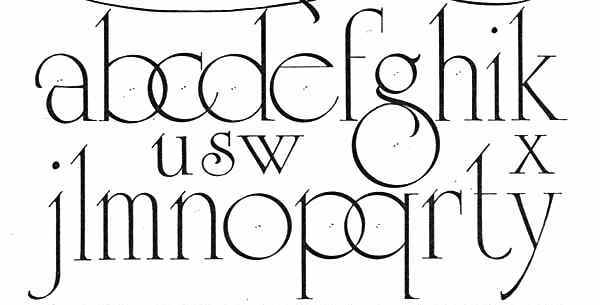
Lettering: Victor Caruso, Photo-Lettering Inc. and ITC


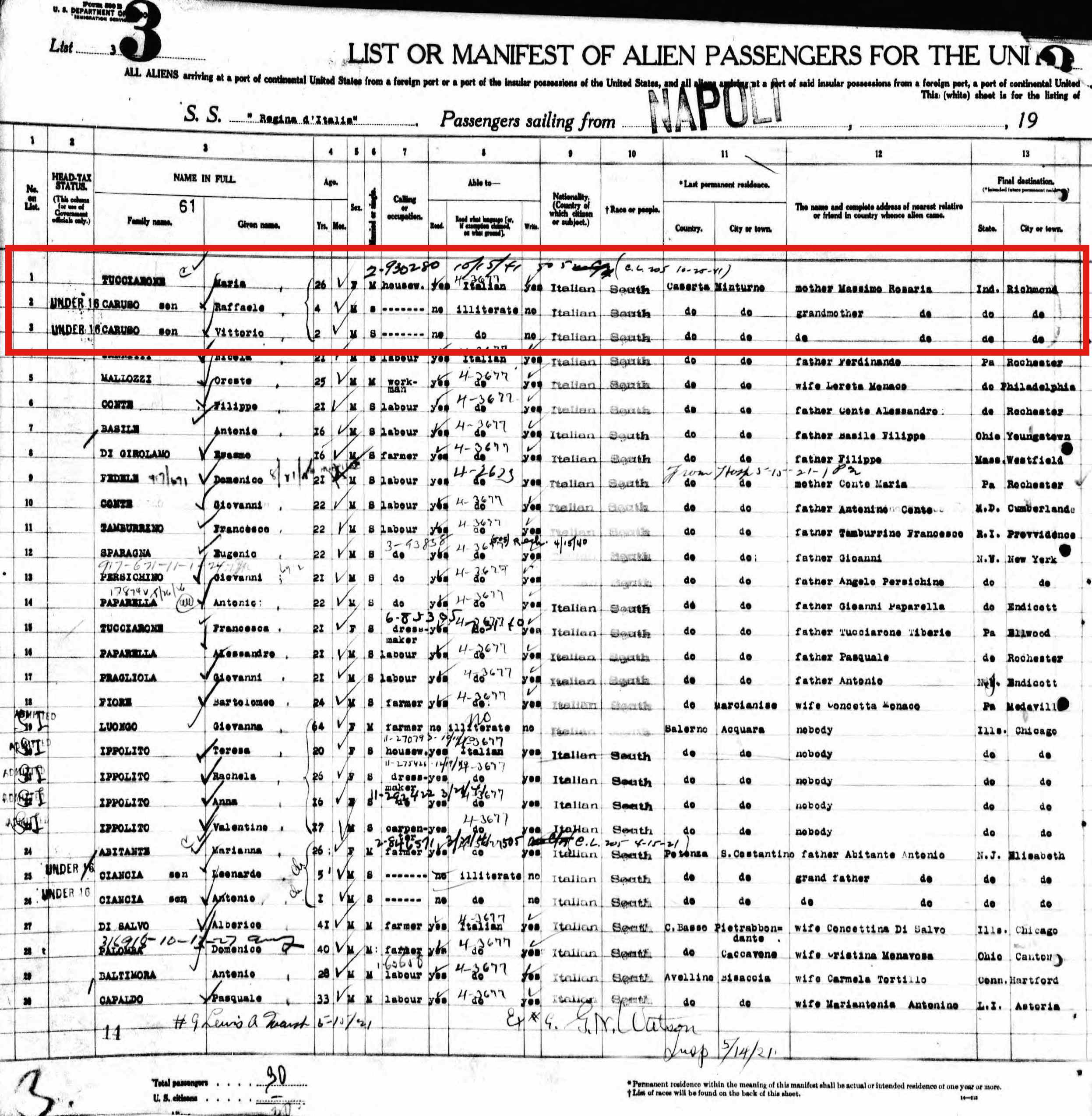
Victor Andrew Caruso was born on December 17, 1919, in Tufo Di Minturno, Italy, according to his World War II draft card. On May 12, 1921, “Vittorio Caruso”, his mother and brother arrived in the port of New York. They traveled on the steamship Regina D Italia from Napoli. 


In the 1925 New York state census, Caruso was the second of four children born to Gervasio and Maria. His father was a coal man. The family resided in Manhattan at 401 East 121st Street.


The 1930 United States Census recorded Caruso, his parents, older brother, Ralph, two younger sisters, Letizia and Rose, and brother, Albert, at 451 East 116th Street in Manhattan. 


Caruso graduated from the High School of Commerce in 1937. 


According to the 1940 census, the Caruso family had grown to nine people. Their home was in the Bronx at 480 East 179th Street. Caruso was a checker at a department store. He earned $888 in 1939. His highest level of education was the fourth year of high school. 


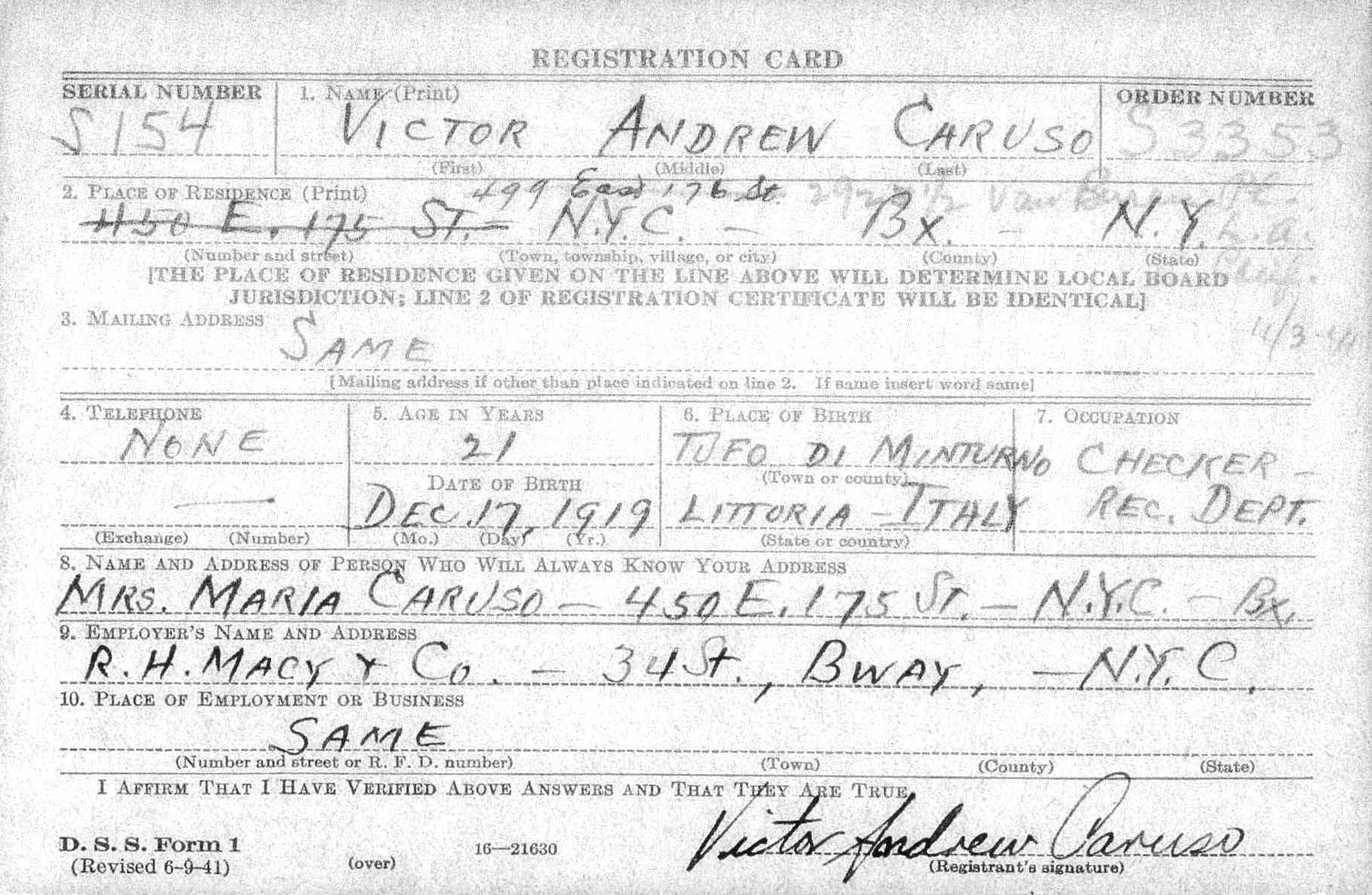
On July 1, 1941, Caruso signed his World War II draft card. He lived with his parents at 450 East 175th Street in the Bronx. His employer was R. H. Macy & Co. Caruso was described as five feet nine inches, 170 pounds with brown hair, blue eyes and he wore glasses.

In Life with Letters—as They Turned Photogenic (1981), Edward Rondthaler wrote 
… in Victor Caruso we found a talented letterer whose early introduction to artistic pursuits dated back to his days as a member of the Boy’s Club of America. In depression years the membership fee was thoughtfully matched to a boy’s depressed pocketbook: 10¢ for six months. As fortune would have it, the club’s perceptive librarian sensed Vic’s talent and steered him into high school art courses, then to Pratt Institute and the National Academy of Art. In 1945 after V-E Day his buddies in arms rushed to get the first boat home, but Vic wisely resisted the temptation, remained in Paris, and studied at the Sorbonne’s Ecole de Beaux Arts. This prepared him for a ten year stint with the accomplished letterer Paul Beers in New York, following which he came to Photo-Lettering and mastered the exacting art of alphabet design. Vic is responsible for more than a thousand faces in Photo-Lettering’s library—a prodigious number; probably more than anyone in the world has ever drawn, and many of them among our best.
A marriage record at Ancestry.com said Caruso married Ila M. Tullis on June 24, 1946 in Miller County, Arkansas. 

The 1950 census said Caruso was a commercial artist at a studio. He, his wife and two sons, Victor and John, lived in Waldwick, New Jersey at 16 Stuart Street. 


Caruso joined Photo-Lettering Inc. in the mid-1950s. Photo-Lettering Inc. advertised Caruso Ruby in Art Direction, November 1956. The May-June 1958 issue of Print magazine featured an advertisement for Caruso’s Baskervale typeface. Caruso Roxy was in Art Direction, September 1961.

Art Direction, November 1956

Art Direction, September 1961
 
1974, Friz Quadrata specimen book
… The bold weight adaptation of Friz Quadrata was executed by Victor Caruso, designer with Photo-Lettering Inc.


1976, ITC Korinna specimen book
… Enriching of the flavor and augmenting the letter into a useful series of four weights and an outline is the work of Ed Benguiat, Vic Caruso and the staff of Photo-Lettering, Inc. …


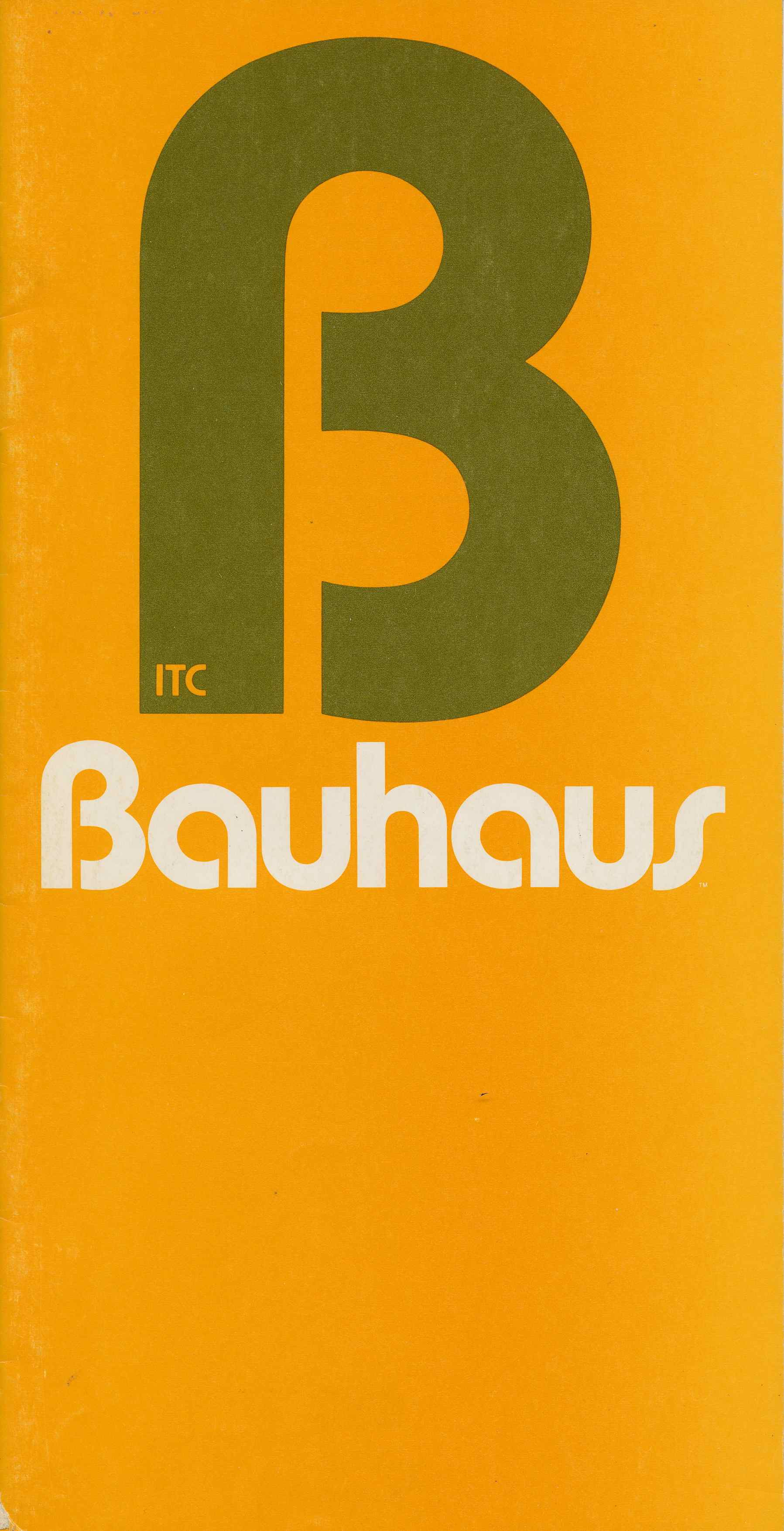
1976, ITC Bauhaus specimen book
ITC Bauhaus was inspired by the Universal typeface designed by Herbert Bayer. The prototypes for the face were created by him while he was a professor at the famed Bauhaus in Dessau, Germany. This distinctive sans serif family was rendered for ITC by Ed Benguiat and Vic Caruso of Photo-Lettering, Inc. …


1976, ITC Clearface specimen book
... In 1978, under license from American Type Founders Company to adapt the original designs for use in contemporary typography, ITC undertook to devote the care and in-depth study that the letterforms of this beautiful typeface truly deserve. To achieve this, ITC commissioned Victor Caruso, Alphabet Designer with Photo-Lettering, inc., to develop a full family of four weights with vigorous italics. ...


1976, ITC Kabel specimen book
... In 1975, under special license from D. Stempel AG, present owners of Kabel, ITC redesigned the original typeface as Rudolph Koch might have chosen to create his Kabel letterforms if the technology of film and phototypesetting had existed in his era. ...
U&lc., March 1978, published a chart of ITC Type Families including ITC Kabel which was designed by Photo-Lettering, Inc. ITC Kabel has been credited to Caruso.


1980, ITC Franklin Gothic specimen book
... In 1979, under license from American Type Founders, ITC undertook to fill this void by creating four new weights in roman and italic (Book, Medium, Demi and Heavy). ITC commissioned Victor Caruso to design these styles with instructions to match as closely as possible the pure characteristics of the original ATF Franklin Gothic. …


U&lc., March 1978

Caruso passed away on February 28, 2016, in New Jersey, according to the New Jersey Death Index at Ancestry.com.


Further Reading
Luc Devroye, Victor Caruso 


(Updated December 24, 2025; next post on Monday: Helen Chu aka Duffy Mohler, Artist and Letterer)


Monday, March 20, 2023

Comics: Barbara Clark Fogel (not Vogel), Timely Artist

Alter Ego #13, March 2002, published an early 1940s photograph of the Timely bullpen. The photograph was provided by artist Dave Gantz who was interviewed by Jim Amash. When Gantz identified the people for Amash, I suspect Fogel was misheard as Vogel. Here are my findings.

Barbara Clark was born on February 14, 1915, in Portland, Oregon, according to the Oregon birth certificate transcription at Ancestry.com. Her parents were William Dennison Clark and Mary Elisa Green who lived at 1069 Thurman Street in Portland.

The 1920 United States Census recorded Barbara as the youngest of three siblings who were Elizabeth and William. The family lived in Riverdale, Oregon.  


According to the 1930 census, Barbara, her mother and brother were in the household of her mother’s sister, Dorothy Green. They resided at 417 Michigan Avenue, in Saginaw, Michigan. 


Barbara attended Arthur Hill High School. Below are details of four group photographs from the 1931 Legende yearbook.


Barbara’s father passed away in May 30, 1932 in Salem, Oregon. 

At some point before 1935 (based on the 1940 census), Barbara, her family and aunt moved to New York City where Barbara may have studied art. When and where she met artist and muralist Seymour Fogel is not known. On November 6, 1936, Barbara and Fogel obtained a Manhattan marriage license and married that day. Barbara’s sister, Elizabeth, was a witness. (Barbara’s aunt, Dorothy Green married Joseph Badger, who was in advertising, on December 24, 1936. Barbara’s mother was a witness.)


Barbara and Fogel signed petitions supporting New York City Communist Party candidates for the 1936 and 1939–1940 elections. 

Barbara and Fogel have not yet been found in the 1940 census. Her mother lived alone in Cincinnati, Ohio. Her brother was a Bodie, California resident. Her sister has not been found. Her aunt was in Wellesley, Massachusetts.

Fogel signed his World War II draft card on October 16, 1940. The address was 70 East 12th Street in Manhattan. The address was updated twice, first at 159 West 23rd Street, and second at General Delivery in Safford, Arizona, where, under a WPA program, Fogel painted a mural at the post office. 


Barbara found work at Timely Comics in the early 1940s but it’s not clear which comics she contributed to. She is not listed at Who’s Who of American Comic Books 1928–1999 and the Grand Comics Database. Mystic Comics #2, Fall 1944, published an Angel story, “Blueprint For Destruction”, with a villain named Fogel. Her comics career ended by 1946 when she moved to Austin, Texas. That same year, Fogel made his debut according to Art Digest, February 1, 1946. 

In the 1950 census, Barbara, her husband, daughter “Gail” [Gayle], and son Jared, lived in Austin, Texas at 2410 Leon Street. 

Barbara and Fogel’s house was placed on the National Register of Historic Places in 2003. Here are excerpts from the application at the Texas Historical Commission
... Fogel moved to Texas with his wife Barbara and baby daughter Gayle in 1946 to teach art at the University of Texas. In 1952, Fogel purchased the Hachenberg barn and set about turning it into his new home and studio with the help of his friend and local architect Harold E. (Bubi) Jessen and carpenter Joe (Austin Joe) Williams. Although Jessen drew up the blueprints of the house for city permits, Fogel designed the house and built it together with Williams (Laurel, 2002.) They completed the single story Usonian style house in 1953. At the time, the Fogel House was reportedly the only structure of its type in Austin. 

... Fogel sold the house and property to Mildred Ferguson in 1960. ... Fogel moved to Connecticut in 1960 and established a studio in Manhattan. ... 
Barbara’s son, Jared, said the family moved in 1959 and “In the early 1960s, he [Fogel] rented a home in Weston, Connecticut, and maintained studios in New York City, first at East 17th Street and later a loft on Canal Street.” The 1972 Weston, Connecticut city directory listed the Fogels at 68 Georgetown Road.

Barbara passed away on October 17, 1980, in Norwalk, Connecticut, according to the Connecticut Death Index at Ancestry.com. Her last residence was in Weston. Her husband passed way on December 4, 1984. 


Further Reading
Barbara was the source for an article about her grandfather, Charles H. Clark, published in Arizona Highways, September 1957. (Free download at the Arizona Memory Project.) 
 
U.S. General Services Administration, Fine Arts Collection, Seymour Fogel murals: “Security of the People” (1942), “Wealth of the Nation” (1942)

Vintage Texas Paintings, Seymour Fogel 

Russell Tether Fine Arts Associates, “The American Scene and Public Art During the Great Depression”
The article has a quote by Barbara about Diego Rivera’s mural at Rockefeller Center.


Women in Comics Posts


Monday, March 13, 2023

Alphabets: Stunt Roman by Ross F. George


Ross F. George and W. H. Gordon were the inventors of the Speedball pens. George’s Speedball alphabet, Stunt Roman, was an inspiration to other designers

The Speedball Text Book 10th Edition (1927) did not have this alphabet. The first showing of Stunt Roman appeared in the Speedball Text Book 11th Edition (1929). Two versions of George’s monogram also appeared in the book: on page six and between the words Stunt and Roman. 


Stunt Roman appeared in the Speedball Text Book 12th Edition (1935). 

The Speedball Text Book 13th Edition (1937) is not available for online viewing. In Phototypography: A Guide to In-House Typesetting and Design (1980), Allan Haley said 
... University Roman was first called Stunt Roman and was an example of hand lettering. The alphabet dates back to 1937 and owes its origin to the humble Speedball lettering pen. In conjunction with their product line of artist’s pens, the Speedball Company published an idea-book for young designers. University Roman was first shown in one of these books and titled Stunt Roman. ...
In the Speedball Text Book 14th Edition (1941), some of the letterforms evolved from the 1929 version and probably appeared in the 13th edition. Compass pinholes are visible in several letters. George also designed a new monogram.


The date looks like 1934

11th Edition

14th Edition

11th Edition

14th Edition

11th Edition

14th Edition

11th Edition

14th Edition

15th Edition (1948) with figures

Stunt Roman with figures appeared in the Speedball Text Book 16th Edition (1952), Speedball Textbook 17th Edition (1956), Speedball Text Book 18th Edition (1960; George’s monogram removed from alphabet) and other editions. The 24th edition has a page with many of George’s monograms


Monday, March 6, 2023

Comics: Alberta Tews, Writer, Assistant Editor and Letterer

Alberta Emma Tews was born on October 28, 1917, in New York, New York, according to her Social Security application at Ancestry.com. Tews parents were Albert August Tews and Emma Bodach. 

The Tews family has not yet been found in the 1920 United States Census. 

The 1930 census recorded Tews, her parents and older sister, Wanda, in Weehawken, New Jersey at 1802 Willow Avenue. Her father was a barge captain. Some time after 1935 the family moved. 


The Jersey Journal (Jersey City, New Jersey), January 29, 1932, mentioned Tews, a Woodrow Wilson High School student, who performed a newsboy dance on the International Night program. 

Tews was a member of the Mecca Assembly, Order of the Rainbow for Girls, Doric Temple in Union City. The Jersey Journal, January 20, 1933, said she was the color Green officer. According to the Jersey Journal, September 9, 1933, Tews, of West New York, was the chaplain. Jersey Journal, January 18, 1935, reported her as drill leader. 

According to the 1940 census, Tews and her parents were Brooklyn, New York residents at 175 34th Street. Tews was employed as a clerk at a business office. 


Tews was named next of kin on her father’s World War II draft card that was signed on April 27, 1942. Her home address was the same. 


Tews had a brief career in the comic book industry. Tews was credited for scripting the Miss Victory story in Captain Fearless Comics #2, September 1941. Her name appeared as Al. Tews on the splash page. Miss Victory appeared in Captain Aero Comics, #12, June 1942. Tews used the pseudonym Tuesday on The Ragman story in Cat-Man Comics, #7, January 1943. The Grand Comics Database has a few more of Tews’s 1940s credits. It’s doubtful she did any comics during the 1950s because she had a family in Michigan. 

Jim Amash interviewed Vincent Fago, of Timely Comics, in Alter Ego #11, November 2001. Fago said
Alberta Tews was also a freelance letterer. One day she came in and told me she'd had her teeth knocked out playing basketball the day before. She said it was no big deal because they were false teeth, even though she was a young girl.
Tews’ comics career ended when she joined the military. The Brooklyn Eagle (New York), February 22, 1943, reported the start of her service. 
Three Borough Women Are Among First in N.Y. to Join Marine Corps

Three Brooklynites are among the first 14 women to join the Marine Corps Women’s Reserve in this area. They were sworn in as privates Saturday by Lt. Col. Frank V. McKinless, in charge of the Office of Procurement and Women’s Reserve Recruiting at 33 Pine St., Manhattan. 

The “Ipathernecks” from this borough are Alberta Tews of 175 34th St., assistant editor of a comic magazine publishing firm, and Dorothy Lonergan and Mary Jingold, telephone operators, both of 2421 E. 38th St.

The recruits will begin training at Hunter College on March 5 and after a six-week indoctrination course will receive two weeks of marine corps instruction. Women officer candidates begin training at Smith College on March 13.

The Brooklyn Eagle, April 6, 1943, said “Enlisted marines at the Bronx training school are ... Alberta Tews of 175 34th St. …”

In North Carolina, Tews met another Marine, Forrest Willard Van Dorn. They married on March 4, 1944 in Craven, North Carolina. 


The July 15, 1944 Brooklyn Eagle said “Alberta E. Tews of 175 34th St. has been promoted to corporal at Cherry Point, N.C.”

According to a January 1945 Marine Corps muster roll, at Ancestry.com, Tews was a sergeant and mechanic at the Aviation Women’s Reserve Headquarters Squadron 18, AWRG-1 U.S.M.C. Air Station, Cherry Point, North Carolina.

Her husband’s address was updated on his draft card. RFD #1, McComb, Hancock, Ohio was crossed out and replaced with 102 Reading Avenue and then 91 Sharp Street, Hillsdale, Michigan. 


The 1950 census counted Tews, her husband and daughter, Vena, in Hillsdale at 205 Oak Haven. Tews was a housewife and her husband a truck driver. 

There was an Alberta Van Dorn, Alberta VanDorn and Al Van Dorn who contributed to The Craftsman, a magazine about leather crafts. The name appeared in The Craftsman Annual Index, Volume 7, 1962–1963; The Craftsman Annual Index, Volume 9, 1964–1965; and The Craftsman Annual Index, Volume 10, 1965–1966. 

At some point, Tews and her husband retired to Bowman, Georgia. Their address was 453 Herndon Circle. He passed away on March 15, 1996. Four years later, Tews passed away on May 21, 2000 in Georgia.


Comics Letterer Posts


Women in Comics Posts


(Next post on Monday: Stunt Roman by Ross F. George)